


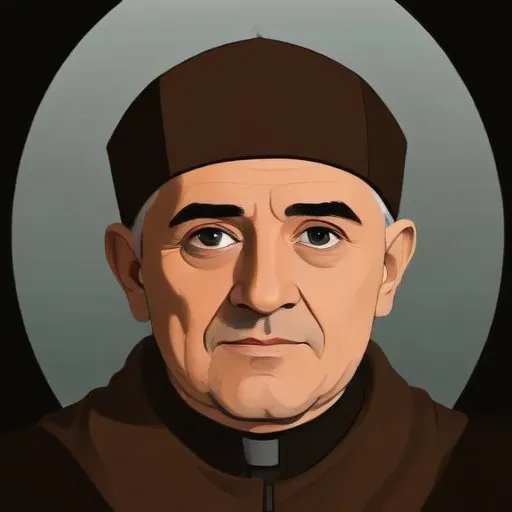
A 19th-century Spanish Discalced Carmelite friar and priest who founded the Congregation of the Carmelite Sisters of Charity and promoted devotion to the Sacred Heart of Jesus. He's revered for his spiritual writings and mystical experiences.
Born on December 29, 1811, in Aitona, Lerida, Francisco was the seventh of nine children to Joseph Palau and Maria Antònia Quer, a devout Catholic family. Growing up amidst the chaos of the Peninsular War, Francisco's family instilled in him a strong sense of faith and community. His parents, fervent royalists, encouraged their children to participate in parish life, and Francisco was an active member of the parish choir.
At the age of 14, Francisco felt an intense calling to become a priest. With the help of his sister Rosa, he pursued higher education, laying the foundation for his future vocation.
Francisco's spiritual journey was deeply rooted in Carmelite spirituality, which emphasized the importance of recognizing and returning God's love. He strongly opposed the rationalist doctrines of his time, instead advocating for a more personal, experiential approach to faith.
His ministry took him to the rural regions of Catalonia, where he preached to the masses and lived as a hermit, exemplifying the Carmelite ideal of contemplation and action. In 1860, he founded the Carmelite Third Order congregation for men and women, which would go on to inspire countless individuals around the world.
In Barcelona, Francisco established the School of Virtue, a groundbreaking institution that provided catechetical instruction to adults. This innovative approach to education aimed to foster a deeper understanding of faith, empowering individuals to live virtuous lives.
The School of Virtue became a beacon of hope for the faithful, attracting seekers from far and wide. Francisco's visionary approach to spiritual formation not only elevated the stature of his congregation but also inspired a new generation of Catholic leaders.
Francisco Palau's contributions to Catholicism extend far beyond his own lifetime. His legacy is carried on by two religious congregations for women, who continue to serve the poor and marginalized across the globe.
One of his most notable spiritual followers was his great-niece, Teresa of Jesus Jornet, who founded a religious congregation dedicated to caring for the elderly poor. Teresa was later honored as a saint, a testament to the enduring power of Francisco's spiritual influence.
In 1988, Francisco Palau was beatified by the Catholic Church, a testament to his extraordinary life of service and devotion. Today, he is revered as a model of Catholic virtue, inspiring countless individuals to embark on their own spiritual journeys.
Through his remarkable life and legacy, Francisco Palau continues to inspire generations of Catholics, embodying the ideals of Carmelite spirituality and humility. His unwavering commitment to faith and the pursuit of virtue has left an indelible mark on the history of Catholicism.
Born in 1515
A 16th-century Spanish mystic and writer who introduced reforms to the Carmelite Order, promoting contemplative prayer and spiritual growth. Her writings are still widely read today.
Born in 1873
A French nun who lived a simple life of prayer and sacrifice, and is revered for her "little way" of trusting in God's love and mercy. She is also known for her writings, which have inspired countless people around the world.
Born in 1491
Founded the Jesuit Order, a Catholic religious organization known for its missionary and educational work, and developed the Spiritual Exercises, a guide for spiritual growth and discernment.
Born in 1581
A 17th-century French priest dedicated his life to serving the poor and marginalized, establishing a congregation of priests and nuns to provide aid and comfort to those in need. He's revered for his selfless charity and compassion.
Born in 1858
A French priest who lived among the Tuareg people in the Sahara Desert, spreading Christianity and advocating for social justice, ultimately giving his life as a martyr.
Born in 1881
A French priest who merged spirituality with science, exploring the intersection of faith and evolution, and proposing a cosmic vision of human destiny. He's famous for his book "The Phenomenon of Man".
Born in 1842
A teenage saint and student of Saint John Bosco, known for his piety, kindness, and heroic virtues, which inspired others to follow in his footsteps. He's often invoked as a patron of youth and students.
