


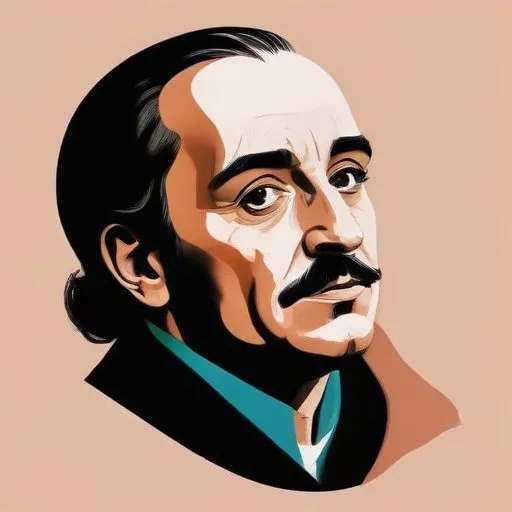
A 17th-century master of satire and wit, known for his clever and humorous writings that critiqued the social and political norms of his time. His works remain a testament to his sharp intellect and literary genius.
If you're familiar with the Spanish literary scene of the 17th century, chances are you've heard of Francisco de Quevedo, a prominent nobleman, politician, and writer of the Baroque era. Known for his unique writing style, dubbed "conceptismo," Quevedo's works rivaled those of his lifelong rival, Luis de Góngora, and continues to influence Spanish literature to this day.
Born on September 14, 1580, in Madrid, Spain, Quevedo was immersed in the world of nobility from a young age. His family, descended from the Castilian nobility, held esteemed positions at the royal court, with his father serving as secretary to Maria of Spain, daughter of Emperor Charles V. This privileged upbringing afforded Quevedo access to the best education available, which he utilized to hone his intellectual gifts.
Quevedo's academic pursuits took him to the Imperial School run by the Jesuits in Madrid, followed by the University of Alcalá de Henares, where he studied from 1596 to 1600. He was an autodidact, indulging in independent studies of philosophy, classical languages, Arabic, Hebrew, French, and Italian. This rigorous intellectual pursuit laid the foundation for his later literary accomplishments.
Quevedo's writing style, "conceptismo," was a stark contrast to the more ornate "culteranismo" of his rival, Góngora. Characterized by a focus on ideas and concepts, Quevedo's works were marked by a concise, witty, and satirical tone, which resonated with the Spanish literary circles of the time.
Quevedo's literary contributions are numerous and varied, with notable works including:
Quevedo's literary innovations and philosophical ideas have had a profound impact on Spanish literature and beyond. His conceptismo style paved the way for future generations of writers, influencing literary movements such as Realism and Surrealism. Today, Quevedo's works continue to be studied and appreciated for their wit, sophistication, and insight into the human experience.
In conclusion, Francisco de Quevedo's remarkable life, marked by intellectual pursuit, literary innovation, and noble lineage, has left an indelible mark on Spanish literature and culture. His legacy serves as a testament to the power of human creativity and intellectual curiosity.
As we delve into the life and works of Francisco de Quevedo, we are reminded of the importance of intellectual curiosity, creativity, and innovation. His remarkable story serves as a testament to the power of human ingenuity and the enduring legacy of Spanish literature.
Born in 1547
Author of the timeless classic "Don Quixote", a foundational work of modern Western literature that has shaped the literary canon and influenced countless writers and artists.
Born in 1562
Renowned playwright and poet who dominated Spain's Golden Age of theater, penning over 1,500 plays and numerous poems that still influence Spanish literature today.
Born in 1600
A 17th-century master of Spanish Golden Age theatre, he penned influential plays that explored complex moral themes, earning him a revered place in literary history.
Born in 1561
A 17th-century Spanish cleric and poet, known for his complex and ornate style, which influenced the development of Spanish literature and poetry. He's credited with creating a new poetic style, known as Culteranismo.
