


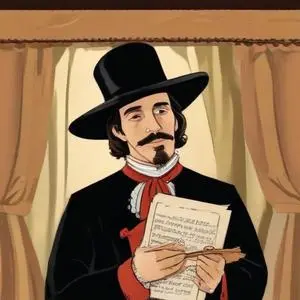
Renowned playwright and poet who dominated Spain's Golden Age of theater, penning over 1,500 plays and numerous poems that still influence Spanish literature today.
Lope de Vega y Carpio, a Spanish playwright, poet, and novelist, is renowned as a key figure in the Spanish Golden Age of Baroque literature. With an staggering literary output of over 3,000 sonnets, three novels, four novellas, nine epic poems, and approximately 500 stageplays, he is second only to Miguel de Cervantes in the literary landscape of Spain.
Lope de Vega's contribution to Spanish theatre was immense, revolutionizing the art form and making it a mass culture phenomenon. Alongside Pedro Calderón de la Barca and Tirso de Molina, he defined the characteristics of Spanish Baroque theatre, offering profound insights into the human condition. His works continue to captivate audiences with their vibrant drama, complex characters, and poetic flair.
Born in Madrid in 1562, Lope de Vega Carpio grew up in a family of modest means. His father, Félix de Vega, was an embroiderer, and little is known about his mother, Francisca Fernández Flores. The young Lope was drawn to literature from an early age, and his paternal grandmother, Catalina del Carpio, is said to have inspired his love for the arts.
Lope de Vega's relationships with his contemporaries were marked by both camaraderie and rivalry. He was close friends with the writer Francisco de Quevedo and the founder of the Poetic Academy of Madrid, Sebastián Francisco de Medrano. However, his arch-nemesis was the dramatist Juan Ruiz de Alarcón, with whom he engaged in a series of public feuds.
Lope de Vega's literary prowess earned him the admiration of luminaries like Johann Wolfgang von Goethe, who praised his vast and colorful oeuvre. His works have had a lasting impact on Spanish literature, influencing generations of writers and shaping the country's cultural identity. Today, he is celebrated as one of the greatest writers in the Spanish language, and his plays continue to be performed and adapted around the world.
"Yo no sé qué es más difícil, si escribir una comedia en un mes o una carta de amores en un momento." ("I don't know what's more difficult, writing a comedy in a month or a love letter in an instant.")
Throughout his life, Lope de Vega remained committed to his art, producing works that continue to captivate and inspire audiences today. His legacy is a testament to the power of literature to transcend time and touch the human heart.
Born in 1600
A 17th-century master of Spanish Golden Age theatre, he penned influential plays that explored complex moral themes, earning him a revered place in literary history.
Born in 1533
A 16th-century Spanish soldier-poet who chronicled the Spanish conquest of Chile in his epic poem "La Araucana", considered one of the greatest works of Spanish literature.
