


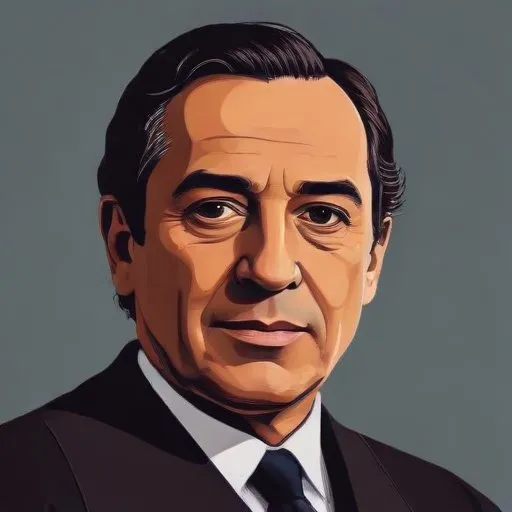
The 111th Prime Minister of Portugal, a lawyer-turned-politician who played a crucial role in shaping the country's democratic transition after the Carnation Revolution. He's most known for his brief but significant tenure as PM, marked by economic reforms and European integration efforts.
Francisco de Sá Carneiro is best known for being the Prime Minister of Portugal from 1980 until his untimely death in 1980, at the age of 46. During his short tenure, he implemented radical economic reforms, earning him both praise and criticism from the Portuguese people.
Born on July 19, 1934, in Porto, Portugal, Carneiro came from a family of intellectuals. He studied law at the University of Lisbon and later pursued a degree in economics from the Technical University of Lisbon.
Carneiro's political career began in the 1960s, when he joined the Portuguese Monarchist Party. However, he soon became disillusioned with the party's right-wing ideology and switched to the Social Democratic Party (PSD). In 1974, he co-founded the PSD with Francisco Pinto Balsemão, among others.
Carneiro's charisma and economic expertise propelled him to the forefront of Portuguese politics. In 1979, he became the leader of the PSD and, subsequently, the Prime Minister of Portugal in 1980.
As Prime Minister, Carneiro introduced sweeping economic reforms, aiming to modernize Portugal's economy and curb rampant inflation. His measures included privatization, deregulation, and austerity policies, which sparked heated debates and protests from trade unions and left-wing groups.
While critics accused Carneiro of being a neoliberal hawk, his supporters praised his bold attempts to liberalize the economy and attract foreign investment. His government's policies led to a significant increase in foreign investment, but also widened the wealth gap and sparked concerns about social inequality.
On December 4, 1980, Carneiro and his companion, Snu Abecassis, died in a mysterious plane crash near Lisbon. The accident remains shrouded in mystery, with various conspiracy theories surrounding the cause of the crash.
Despite his short time in office, Carneiro's reforms had a lasting impact on Portugal's economy and politics. His legacy continues to inspire debates about the role of the state in the economy and the need for bold reforms in times of crisis.
Carneiro was known for his extraverted personality and wit. He once famously quipped, "I prefer to be a good prime minister for one day than a bad one for five years."
In a rare interview, Carneiro revealed his admiration for British economist Friedrich Hayek and his commitment to individual freedom and limited government intervention.
Carneiro's tenure coincided with a period of rapid change in Portugal, marked by the country's transition from an authoritarian regime to a democratic government. His economic reforms were part of a broader trend in Western Europe, as leaders like Margaret Thatcher and Ronald Reagan implemented similar policies.
In conclusion, Francisco de Sá Carneiro's life was a testament to his unwavering commitment to economic reform and individual freedom. His legacy continues to inspire and provoke, serving as a reminder of the power of bold leadership in times of crisis.
Born in 1924
A Portuguese historian, lawyer, and politician who served as the 17th President of Portugal, known for leading the country's transition from authoritarianism to democracy. He played a key role in Portugal's decolonization and European integration.
Born in 1889
A dictator who ruled Portugal from 1933 to 1968, implementing a corporatist authoritarian regime and maintaining a neutral stance during World War II. He's known for his economic reforms and nationalist policies.
70 Years Old
The 118th Prime Minister of Portugal, a lawyer-turned-politician who led the country's government from 2004 to 2005. He's known for his brief but tumultuous tenure, marked by controversy and a no-confidence vote.
70 Years Old
The first Prime Minister of Portugal to serve two consecutive terms, known for his efforts to reform the country's economy and his later role as President of the European Commission.
