


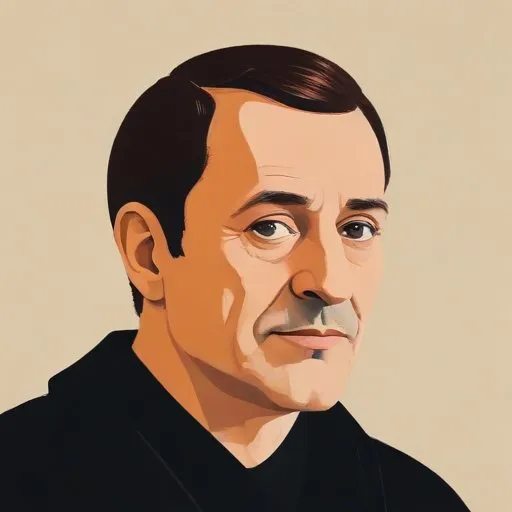
A theorist who developed the concept of "argumentation ethics," which posits that the use of aggression is incompatible with the principles of rational argumentation, and is known for his work on libertarian and anarchist philosophy.
Frank Van Dun, a renowned Belgian philosopher of law, is best known for his groundbreaking work in classical liberal natural law theory. His seminal book, "Het Fundamenteel Rechtsbeginsel" (The Fundamental Principle of Law), published in 1983, laid the foundation for his argumentation ethics, which posits that a rationally convincing answer to the question "What is law" can only be found by respecting dialogue and argumentation.
Van Dun's work is built upon the principle that every natural person has a lawful claim on their life, freedom, and property. This claim is absolute, as long as it does not prohibit the equivalent claims of other natural persons, i.e., as long as argumentation is respected. He makes a clear distinction between the lawful (ius) and the legal (lex), arguing that Western positive law systems reduce people to human resources, artificial persons with merely legal status.
In his view, positive law defines the legal but can only be lawful insofar as individuals have full secession rights from the institutional framework that makes said positive law. This means that no judge can be forced upon a person who is willing to search for a lawful solution to any conflict.
Van Dun's interpretation of the non-aggression principle (NAP) is praxeological rather than physical, as he sees property as a means of action. This leads him to prioritize freedom before property, rather than freedom as property. This implies that it's not necessarily only the last action in the chain of social causations that is unlawful.
In 2013, Van Dun was awarded the Prize for Liberty by the Flemish classical liberal think tank Libera, a testament to his influential work in the field of law and philosophy.
Van Dun's work has had a significant impact on modern thought, particularly in the areas of law, philosophy, and politics. His ideas on natural rights and the non-aggression principle have influenced a generation of scholars and thinkers.
Through his work, Van Dun has left an indelible mark on the fields of law and philosophy, inspiring new generations of thinkers to engage with the fundamental principles of justice and human rights.
77 Years Old
Austrian School economist and philosopher who advocates for libertarian anarchism and critiques democracy, known for his radical views on politics and economics.
Born in 1926
A prominent figure in the Austrian School of economics, known for his libertarian and anarchist views, and his work on the history of economic thought.
Born in 1881
A pioneer of Austrian economics, he developed the concept of praxeology, which focuses on human action and its consequences, and is known for his critiques of socialism and central planning.
Born in 1899
Austrian economist and philosopher who championed free market capitalism and limited government intervention, warning of the dangers of socialism and totalitarianism. His work influenced economic policy and shaped modern libertarian thought.
Born in 1905
Russian-born American novelist and philosopher who wrote influential novels like "The Fountainhead" and "Atlas Shrugged", promoting individualism and capitalism.
87 Years Old
A renowned philosopher who challenged traditional notions of justice, morality, and the role of government, known for his influential book "Anarchy, State, and Utopia".
Born in 1921
Developed the concept of "justice as fairness" and argued that a just society should be based on principles that would be agreed upon by rational individuals behind a "veil of ignorance".
Born in 1724
Developed influential philosophical frameworks, such as the Critique of Pure Reason, that shaped modern Western thought on ethics, morality, and human understanding.
