


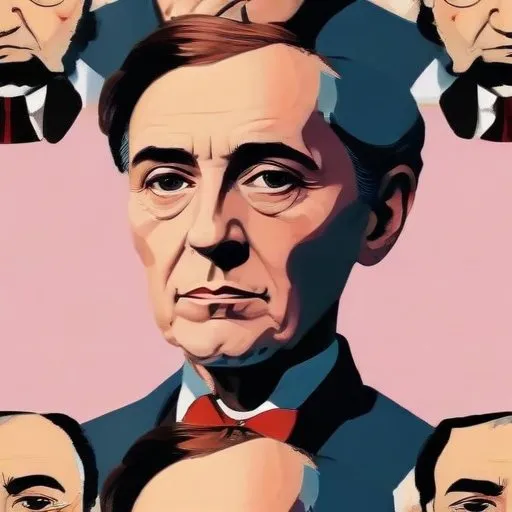
A 19th-century French historian and politician who served as Prime Minister, known for his role in shaping France's modern democracy and educational system.
Franois Guizot, a renowned French historian, orator, and statesman, is best known for his pivotal role in shaping modern France's political landscape. As a dominant figure in French politics prior to the Revolution of 1848, Guizot's unwavering commitment to constitutional monarchy and public education reform left an indelible mark on the nation.
Born on October 4, 1787, in Nimes, France, Guizot was destined for greatness. His early years were marked by a passion for learning, which eventually led him to become a professor of history at the University of Paris. However, it was his entry into politics that catapulted him to national prominence.
In 1830, Guizot played a crucial role in the July Revolution, which saw the overthrow of King Charles X and the ascendancy of Louis Philippe to the throne. As a staunch advocate for constitutional monarchy, Guizot worked tirelessly to ensure the new government's stability and legitimacy. His efforts were rewarded with appointments to various ministerial positions, including Minister of Education and Foreign Minister.
Guizot's most significant contribution to French society was his relentless pursuit of education reform. As Minister of Education, he oversaw the creation of primary schools in every French commune, a move that revolutionized access to education for the masses. This development had far-reaching consequences, empowering future generations to participate actively in the country's political and economic life.
As a leader of the Doctrinaires, Guizot advocated for the limitation of suffrage to propertied men. This stance earned him the ire of more liberal factions, who felt that his policies were restrictive and exclusionary. However, Guizot remained steadfast in his belief that education and economic empowerment were essential prerequisites for responsible citizenship.
In 1847, Guizot became Prime Minister of France, a position he held until the outbreak of the 1848 Revolution. His tenure was marked by controversy, particularly the ban on political meetings, which sparked widespread protests and eventually led to the downfall of the monarchy.
In the famous opening paragraph of the Communist Manifesto, Karl Marx and Friedrich Engels mentioned Guizot as a representative of the liberal faction of the counterrevolutionary forces of Old Europe. This passage highlights the complexity of Guizot's legacy, which continues to be debated by historians and scholars.
"Enrichissez-vous" ("Enrich yourselves") - Guizot's advice to those seeking the right to vote, emphasizing the importance of education and economic empowerment.
Franois Guizot's life and legacy continue to fascinate historians and scholars. While his stance on suffrage and education reform remains controversial, his contributions to modern France's development are undeniable. As a testament to his enduring impact, Guizot's name remains synonymous with the struggles and triumphs of 19th-century France.
Born in 1768
A French historian and politician who served as Minister of Foreign Affairs, known for his influential writings on French history and politics, shaping the country's identity and foreign policy.
Born in 1769
A French military leader who rose to prominence during the French Revolution and became Emperor of France, known for his military conquests and reorganization of Europe. He is also famous for his Napoleonic Code, which remains a foundation of modern law.
Born in 1790
A 19th-century French poet and politician who served as the country's Head of State, known for his romantic poetry and instrumental role in the French Revolution of 1848.
