


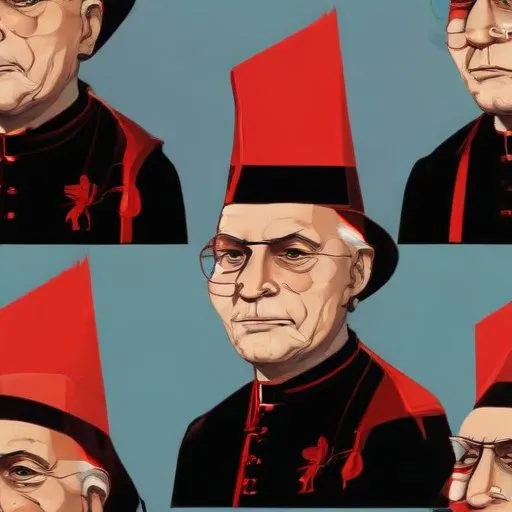
Austrian Catholic Church leader who served as Archbishop of Vienna and played a key role in shaping the church's stance on social justice and ecumenism. He was a vocal advocate for human rights and reconciliation during a tumultuous period in European history.
Franz König, an Austrian Cardinal of the Catholic Church, was a pivotal figure in the Catholic hierarchy, serving as the Archbishop of Vienna from 1956 to 1985 and being elevated to the cardinalate in 1958. He is best known for being the longest-serving cardinal of the 20th century, earning him a distinctive place in the history of the Catholic Church.
König was born on August 3, 1905, in Warth, near Rabenstein, Lower Austria, as the oldest of nine children to Franz and Maria König. He pursued his education at the Benedictine-run Stiftsgymnasium Melk and later at the Pontifical Gregorian University in Rome, where he received his doctorate in philosophy in 1930 and theology in 1936. His academic pursuits didn't stop there; he also studied at the Pontifical German-Hungarian College, the Pontifical Biblical Institute, and the Université Catholique de Lille.
König's priestly ordination took place on October 29, 1933, by Cardinal Francesco Marchetti-Selvaggiani. Initially, he served as a chaplain and teacher, with a focus on youth ministry during World War II. Following the war, he embarked on an academic career, becoming a Privatdozent, and later teaching religion at the College of Krems and the University of Vienna from 1945 to 1948 and moral theology at the University of Salzburg from 1948 to 1952.
On July 3, 1952, König was appointed Coadjutor Bishop of Sankt Pölten and Titular Bishop of Livias by Pope Pius XII. He received his episcopal consecration on August 31, 1952, from Bishop Michael Memelauer, with Bishops Leo Pietsch and Franz Zauner serving as co-consecrators. His elevation to the cardinalate came in 1958, and he was named Cardinal-Priest of Sant'Eusebio.
König's tenure as Archbishop of Vienna began in 1956, succeeding Theodor Innitzer. During his nearly three-decade-long service, he played a crucial role in shaping the Catholic Church in Austria and beyond.
Franz König's legacy is marked by his unwavering commitment to the Catholic Church and his dedication to fostering a deeper understanding of the faith. As the longest-serving cardinal of the 20th century, he witnessed and participated in significant events that shaped the Church's history, including the Second Vatican Council. His influence extended beyond Austria, earning him recognition as a respected theologian and a stalwart defender of the faith.
"The Church is not a museum, but a living, dynamic reality that must constantly adapt to the needs of the times."
"The priest is not a master, but a servant, and his task is to help people find their way to God."
Franz König's life was a testament to his unwavering dedication to the Catholic Church and his unshakeable faith. His remarkable legacy continues to inspire generations of Catholics around the world.
Born in 1417
A 15th-century pope who played a significant role in the fall of the Western Schism, ending the division in the Catholic Church. He's also known for his lavish spending and nepotism.
Born in 1920
Leader of the Catholic Church from 1978 to 2005, known for helping to end communism in Poland and being a charismatic advocate for human rights and social justice.
99 Years Old
The first pope to resign in nearly 600 years, he's known for his conservative views and efforts to strengthen the Catholic Church's traditional teachings. He's also a prolific writer and theologian.
89 Years Old
The leader of the Catholic Church, known for his progressive stance on social issues and efforts to reform the Church, inspiring millions worldwide.
