


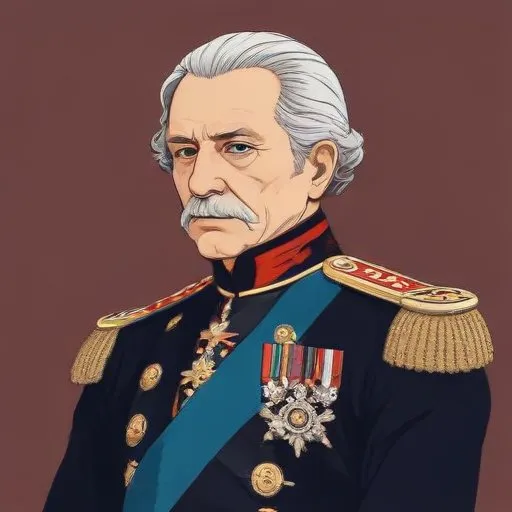
An Austrian nobleman and military leader who played a key role in the Napoleonic Wars, leading Austrian troops to several victories against French forces. He's also known for his reforms of the Austrian army.
Franz Schlik, a count and general in the Austrian Empire, is renowned for his crucial role in the Hungarian Revolution of 1848. As one of the most successful Austrian generals of his time, Schlik's military prowess and strategic thinking proved decisive in shaping the outcome of the revolution.
Born on May 23, 1789, in Prague, Schlik was the son of Count Joseph Heinrich Schlik of Bassano and Weisskirchen and his wife, Countess Philippine Ludmilla of Nostitz-Rieneck. He enrolled in the imperial army in 1808 and fought in the Napoleonic Wars, where he lost sight in his right eye during the Battle of Leipzig in 1813.
In 1848, Schlik became a lieutenant general and was appointed regent of Kraków in Poland. This strategic position allowed him to play a key role in the Hungarian Revolution, which was sparked by the Hungarian Military Commission's rebellion against the Austrian Empire.
Schlik's military campaigns during the Hungarian Revolution were marked by several crucial battles and victories. On December 11, 1848, he defeated Sándor Pulszky in the Battle of Budamér, and on December 28, 1848, he triumphed over Lázár Mészáros in the Battle of Szikszó. Schlik's forces also captured Eperjes (now Prešov, Slovakia) and Kassa (now Košice, Slovakia).
Schlik's military successes and strategic thinking had a significant impact on the Hungarian Revolution. His victories served as a warning to the Hungarian Military Commission, and his battles paved the way for further Austrian victories. Although the Hungarians eventually defeated the Austrian forces, Schlik's legacy as a brilliant military strategist endures.
Little is known about Schlik's personal life, but it is recorded that he died on March 17, 1862, in Vienna. His military career and contributions to the Austrian Empire remain his most enduring legacy.
Franz Schlik's life and career serve as a testament to his military prowess and strategic thinking. His crucial role in the Hungarian Revolution of 1848 continues to inspire historians and military enthusiasts alike, solidifying his place in the annals of Austrian history.
Born in 1793
Emperor of Austria from 1835 to 1848, known for his role in the Revolutions of 1848 and his abdication in favor of his nephew Franz Joseph.
Born in 1887
Last Emperor of Austria-Hungary, ruling from 1916 to 1918, and known for his attempts to reform the empire and end World War I.
Born in 1663
A brilliant military strategist and statesman, he led the Holy Roman Empire to numerous victories against the Ottoman Empire, earning him legendary status in European history.
