


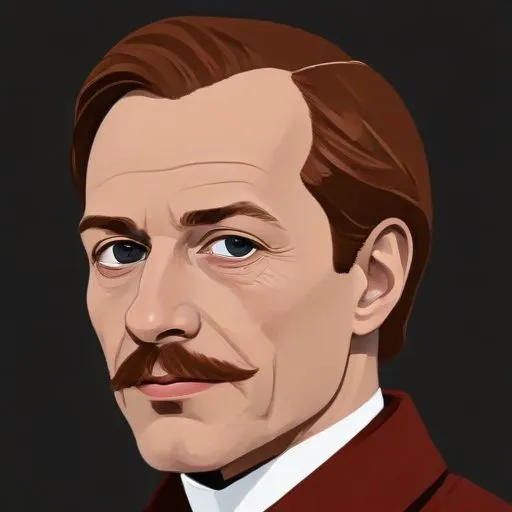
A renowned 19th-century painter of portraits and landscapes, capturing the essence of the German aristocracy and landscapes with remarkable realism. His works are celebrated for their intricate details and lifelike quality.
Franz von Lenbach, born in 1836, was a renowned German painter celebrated for his exquisite portraits of aristocrats, artists, and industrialists. Dubbed the "Malerfürst" or Painter Prince, Lenbach's works continue to captivate art enthusiasts with their precision, elegance, and sensitivity.
Born in Schrobenhausen, Lenbach came from a humble background; his father was a Master Mason. After completing his primary education in Landsberg, Lenbach attended a business school in Landshut. However, his artistic inclinations soon took over, and he was apprenticed to the sculptor Anselm Sickinger in Munich.
After his father's demise, Lenbach returned home to assist with the family business, but his artistic calling was too strong. He enrolled at the Augsburg University of Applied Sciences, where he honed his drawing and painting skills in his spare time. This marked the beginning of his journey towards becoming a painter.
Lenbach's talent soon earned him a place at the Academy of Fine Arts, Munich, where he studied under the guidance of Hermann Anschtz and later, Karl von Piloty. His breakthrough came in 1858 with an exhibition at the Glaspalast, which led to a travel scholarship and a journey to Rome with Piloty.
Upon his return to Munich, Lenbach started receiving portrait commissions, solidifying his reputation as a master portraitist. His travels to Paris and Brussels further refined his skills, and his works began to gain international recognition. As a professor at the Weimar Saxon Grand Ducal Art School, Lenbach took his students on painting expeditions en plein air, imparting his knowledge and passion for art.
Throughout his career, Lenbach created an impressive body of work, comprising over 1,000 portraits. His mastery of capturing the essence of his subjects, combined with his extraordinary attention to detail, has left an indelible mark on the world of art. As the Painter Prince of Munich, Lenbach continues to inspire artists, art historians, and enthusiasts alike.
As we delve into the life and works of Franz von Lenbach, we are reminded of the power of art to transcend time and capture the essence of humanity.
Franz von Lenbach's remarkable journey, marked by dedication, passion, and innovation, has left an enduring legacy in the world of art. As we celebrate his life and works, we are inspired to continue exploring the realm of human creativity, and the boundless potential of the human spirit.
Born in 1808
A 19th-century German Romantic painter and poet, known for his humorous and satirical depictions of everyday life, often featuring bumbling bureaucrats and romanticized landscapes.
Born in 1848
A German painter and educator, he's most known for his Impressionist and Realist works, often depicting everyday life and landscapes, and for teaching at the Munich Academy of Fine Arts.
