


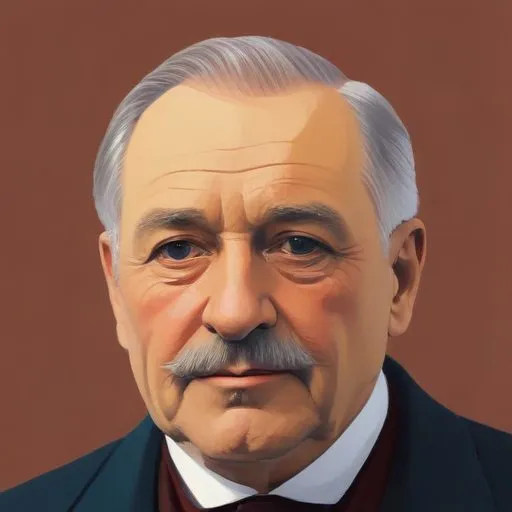
A German painter and educator, he's most known for his Impressionist and Realist works, often depicting everyday life and landscapes, and for teaching at the Munich Academy of Fine Arts.
Fritz von Uhde, born Friedrich Hermann Carl Uhde on May 22, 1848, was a German painter of genre and religious subjects, renowned for his unique blend of Realism and Impressionism. He is often referred to as Germany's outstanding impressionist, and his pioneering work introduced plein-air painting to his native country.
Uhde was born in Wolkenburg, Saxony, to a moderately wealthy family of civil servants with artistic inclinations. His father was a part-time painter, and his maternal grandfather was the director of the Royal Museums in Dresden. This artistic upbringing sparked Uhde's interest in art, which he pursued at the Gymnasium in Dresden.
In 1866, Uhde was admitted to the Academy of Fine Arts in Dresden, but his stay was short-lived. He left the academy to join the army, where he became a horsemanship instructor and eventually rose to the rank of Lieutenant in 1868.
In 1876, Uhde's encounter with the painter Hans Makart in Vienna marked a turning point in his life. He left the army in 1877 to pursue a career in art, relocating to Munich to attend the Academy of Fine Arts. It was during this period that he developed a deep admiration for Dutch old masters, particularly Rembrandt.
Uhde's artistic journey continued in Paris, where he studied under Mihály Munkácsy's supervision in 1879. His studies of the Dutch painters and nature itself helped shape his unique style. His determination to succeed quickly led him to exhibit his work at the Paris Salon of 1880, where he received an honorable mention for his painting, The Singer.
A journey to the Netherlands in 1882 revolutionized Uhde's style, as he abandoned the dark chiaroscuro he had learned in Munich in favor of a vibrant colorism. This shift marked a significant milestone in his artistic development, solidifying his position as a leading figure in German Impressionism.
Fritz von Uhde's contributions to German art are immeasurable. He not only introduced plein-air painting to his country but also inspired a generation of artists, including Lilla Cabot Perry, whom he taught and influenced. Uhde's unique blend of Realism and Impressionism continues to inspire artists and art enthusiasts alike, cementing his legacy as a luminary of German art.
Fritz von Uhde's life was marked by significant personal milestones, including his decision to leave the army to pursue art. He married in 1884 and had two children, but tragically lost his son in 1898. Uhde passed away on February 25, 1911, leaving behind a legacy that continues to inspire and enrich the world of art.
Through his life and work, Fritz von Uhde demonstrated an unwavering dedication to his craft, pushing the boundaries of German art and cementing his place as one of the country's most celebrated Impressionists.
Born in 1847
A leading figure in German Impressionism, he's renowned for his vibrant, expressive portraits and landscapes that captured the essence of Berlin's urban life. His work continues to inspire artists and art enthusiasts alike.
Born in 1858
A German painter who blended Impressionism and Expressionism to create vibrant, emotive works that explored the human condition, often focusing on portraits and landscapes.
Born in 1884
A German Expressionist master, known for vibrant, emotive paintings and etchings that capture the intensity of modern life, blending primitivism with modernity.
Born in 1867
A pioneering Expressionist artist, known for vibrant, emotive paintings and prints that explored the human condition, often with a focus on spirituality and the natural world.
Born in 1880
A German soldier-turned-painter who pioneered Expressionism, capturing the emotional essence of animals and landscapes in vibrant, abstracted forms. His work continues to inspire artists and art lovers alike.
Born in 1887
A pioneering expressionist painter who captured the vibrant spirit of early 20th-century Europe through bold, colorful works that blended Fauvism and Cubism. His innovative style continues to inspire artists today.
Born in 1866
A pioneer of abstract art, creating vibrant, expressive works that explored the emotional and spiritual properties of color, and wrote extensively on art theory.
