


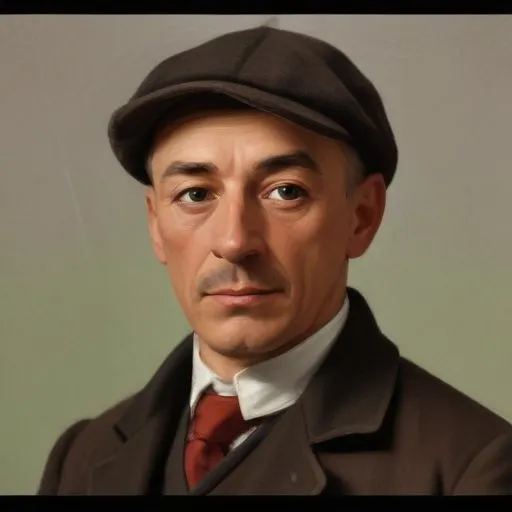
A leading figure in German Impressionism, he's renowned for his vibrant, expressive portraits and landscapes that captured the essence of Berlin's urban life. His work continues to inspire artists and art enthusiasts alike.
Max Liebermann was a German painter and printmaker who spearheaded the Impressionist movement in Germany and continental Europe, earning him a reputation as one of the most influential artists of his time. With a career spanning over six decades, he was celebrated for his captivating portraits, serene landscapes, and poignant depictions of everyday life.
Born on July 20, 1847, in Berlin, Germany, to a Jewish banker, Liebermann's artistic talent was nurtured from an early age. He studied art in Weimar, Paris, and the Netherlands, where he was exposed to the works of the French Impressionists, which had a profound impact on his style.
After settling in Munich, Liebermann's work gained recognition, and he returned to Berlin in 1884, where he remained until his death. His portraits, in particular, earned him great acclaim, with over 200 commissioned works, including those of illustrious figures such as Albert Einstein and Paul von Hindenburg.
Liebermann's contributions to the art world extended beyond his own creations. He was honored with a solo exhibition at the Prussian Academy of Arts in Berlin on his 50th birthday and was elected to the academy the following year. From 1899 to 1911, he led the Berlin Secession, a premier avant-garde formation in Germany. He later became the president of the Prussian Academy of Arts in 1920, a position he held until 1933, when he was forced to resign due to the Nazi regime's restrictions on Jewish artists.
Liebermann's work was characterized by a unique blend of Realism and Impressionism. He was drawn to the works of French Impressionists, such as Claude Monet and Camille Pissarro, and incorporated their techniques into his own practice. His subjects ranged from intimate family scenes to bustling urban landscapes, all infused with a sense of realism and attention to detail.
Liebermann's achievements were recognized with numerous awards and honors. On his 80th birthday, he was celebrated with a large exhibition, declared an honorary citizen of Berlin, and featured on the cover of Berlin's leading illustrated magazine. Despite the accolades, his later years were marked by struggles against the Nazi regime, which ultimately led to the looting of his art collection after his death.
Liebermann was a staunch advocate for the separation of art and politics. He believed that artists should be free to create without ideological constraints, a philosophy that resonated with his contemporaries and continues to inspire artists today.
Liebermann's personal life was marked by milestones and key events. He married Martha Marckwald in 1884, and the couple had two children together. His later years were marked by struggles against the Nazi regime, which led to his resignation from the Prussian Academy of Arts in 1933. He passed away on February 8, 1935, leaving behind a legacy that continues to inspire artists and art lovers alike.
Liebermann's later years were marked by controversy, particularly his resignation from the Prussian Academy of Arts in 1933. This decision was seen as a testament to his commitment to artistic freedom and his refusal to compromise his principles in the face of political pressure.
Liebermann's impact on modern society extends beyond the art world. His advocacy for artistic freedom and his commitment to his craft continue to inspire artists, policymakers, and individuals alike. His legacy serves as a reminder of the importance of creative expression and the need to protect it from ideological constraints.

As we reflect on Liebermann's life and legacy, we are reminded of the importance of artistic freedom and the need to protect it. In an era marked by increasing polarization, Liebermann's commitment to his craft and his refusal to compromise his principles serve as a beacon of hope for artists and creatives around the world.
Born in 1858
A German painter who blended Impressionism and Expressionism to create vibrant, emotive works that explored the human condition, often focusing on portraits and landscapes.
Born in 1863
A Norwegian painter who created iconic, emotionally charged works that explored the human experience, including the famous piece "The Scream".
Born in 1890
Austrian soldier and painter who captured the intensity of human emotion through bold, expressive portraits and landscapes, often exploring themes of death, sexuality, and the human condition.
Born in 1886
Austrian-Swiss artist who pioneered Expressionism through vibrant, emotive paintings and plays that explored the human condition. His works often featured distorted forms and bold colors.
Born in 1880
A German soldier-turned-painter who pioneered Expressionism, capturing the emotional essence of animals and landscapes in vibrant, abstracted forms. His work continues to inspire artists and art lovers alike.
Born in 1887
A pioneering expressionist painter who captured the vibrant spirit of early 20th-century Europe through bold, colorful works that blended Fauvism and Cubism. His innovative style continues to inspire artists today.
Born in 1864
A Russian-German painter who pioneered Expressionism, capturing intense emotions through vibrant, distorted forms and bold colors. He's famous for his bold, avant-garde portraits.
