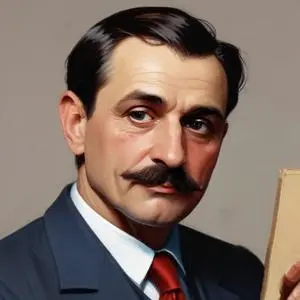
Lovis Corinth: The German Artist who Revolutionized Expressionism
A Synthesis of Impressionism and Expressionism
Lovis Corinth, born Franz Heinrich Louis, is renowned for his bold and vibrant paintings that epitomize the synthesis of Impressionism and Expressionism. As a German artist and writer, Corinth's mature work took the art world by storm, masterfully blending the two styles to create a unique and powerful visual language.
Early Life and Training
Born on July 21, 1858, in Tapiau, Province of Prussia, in the Kingdom of Prussia, Corinth demonstrated a talent for drawing from an early age. He began his artistic training in 1876 at the academy of Königsberg, where he initially intended to become a history painter. However, his instructor, Otto Günther, dissuaded him from this path, and Corinth instead pursued his passion for painting.
Studies in Munich and Paris
In 1880, Corinth traveled to Munich, a hub of avant-garde art, where he briefly studied with Franz von Defregger. He then gained admission to the Academy of Fine Arts Munich, where he studied under Ludwig von Löfftz. Löfftz's emphasis on careful observation of colors and values shaped Corinth's early realism.
Corinth's time in Munich also exposed him to the influences of Wilhelm Leibl and Wilhelm Trübner, who interpreted the Barbizon school's emphasis on outdoor painting and the study of natural light. Except for a brief interruption for military service in 1882-1883, Corinth continued his studies with Löfftz until 1884.
Paris and the Influence of the Barbizon School
In October 1884, Corinth traveled to Paris, where he studied under
William-Adolphe Bouguereau and Tony Robert-Fleury at the Académie Julian. He became enamored with the works of
Gustave Courbet and the Barbizon school, which further solidified his commitment to realism.
Breaking with Tradition: The Emergence of Expressionism
Corinth's early work was characterized by a naturalistic approach, but after a stroke in 1911, his style underwent a significant transformation. His brushstrokes became looser, and his use of color more vibrant, taking on expressionistic qualities. This shift marked a turning point in Corinth's career, as he began to create works that were not only visually stunning but also emotionally powerful.
Presidency of the Berlin Secession
In 1915, Corinth succeeded
Max Liebermann as the president of the Berlin Secession, a group that aimed to promote modern art. This position further solidified Corinth's influence on the art world, as he championed the works of avant-garde artists.
Major Works and Themes
Corinth's oeuvre is characterized by a range of themes, including:
- Portraits: Corinth's portraits are renowned for their psychological depth and sense of humanity.
- Landscapes: His landscapes are masterful studies of light and color, capturing the essence of the natural world.
- Nudes: Corinth's nudes are celebrated for their sensitivity and ability to convey the beauty of the human form.
- Biblical Scenes: His biblical scenes are rich in symbolism and drama, showcasing his skill in storytelling.
Legacy and Impact
Lovis Corinth's innovative style and bold use of color have inspired generations of artists. His synthesis of Impressionism and Expressionism paved the way for a new era of modern art, solidifying his position as one of the most important artists of the early 20th century.
Quotes and Memorable Sayings
"I paint to fulfill a duty, to bring forth what is within me, to give form to the chaos." - Lovis Corinth
This quote captures the essence of Corinth's artistic philosophy, emphasizing the importance of creative expression and the need to bring forth the inner world onto the canvas.
FAQ
What was Lovis Corinths contribution to German art?
Lovis Corinth was a German painter who made significant contributions to the development of German art, particularly in the genre of landscape painting.
What was Lovis Corinths style of painting?
Lovis Corinths style was characterized by a focus on light and color, using bold brushstrokes and vivid hues to capture the natural world and the human experience.
What role did Lovis Corinth play in the development of Expressionism?
As a precursor to Expressionism, Lovis Corinths work influenced the development of the movement, paving the way for artists like Emil Nolde and Edvard Munch.
How did Lovis Corinths work impact the development of modern art?
Lovis Corinths innovative approach to painting helped shape the development of modern art, influencing generations of artists and contributing to the evolution of artistic styles and techniques.
What legacy did Lovis Corinth leave behind?
Lovis Corinths contributions to German art and the development of Expressionism have endured, earning him recognition as a pioneering figure in the history of modern art.