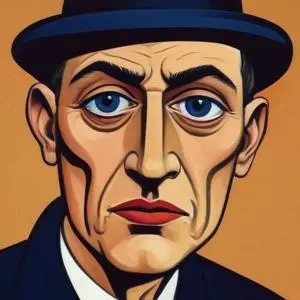
Max Beckmann: The Visionary Artist of the Twentieth Century
A Pioneer of Expressionism and Beyond
Max Beckmann, a German painter, draftsman, printmaker, sculptor, and writer, is renowned for his bold and evocative works that transcended the boundaries of Expressionism. Though he rejected the term, his artistry is characterized by its intense emotionalism, distorted forms, and a blend of brutal realism and social criticism.
Early Life and Inspirations
Born on February 12, 1884, in Leipzig, Saxony, Beckmann was raised in a middle-class family. From a young age, he challenged the conventions of traditional art, pitting himself against the old masters. His traumatic experiences as a medical orderly during World War I profoundly impacted his art, leading to a dramatic transformation of his style.
A Quest for the Self and the Spiritual
Well-read in philosophy and literature, Beckmann delved into mysticism and theosophy, seeking the hidden spiritual dimension in his subjects. He believed that art could reveal the mysteries of the human condition, and his own artistic quest became a search for the Self. This introspective approach is evident in his remarkable self-portraits, which rival those of Rembrandt and Picasso in number and intensity.
Teaching and Honors
Beckmann's talent and influence extended beyond his art. In 1925, he was appointed to teach a master class at the Städel Academy of Fine Art in Frankfurt, where he mentored notable students such as Theo Garve, Leo Maillet, and Marie-Louise von Motesiczky. He received the Honorary Empire Prize for German Art in 1927 and the Gold Medal of the City of Düsseldorf.
Artistic Evolution and Style
Beckmann's artistic development was marked by a series of stylistic transformations. In the 1920s, he was associated with the New Objectivity (Neue Sachlichkeit), which rejected the introverted emotionalism of Expressionism. By the 1930s, his work became more explicit in its horrifying imagery and distorted forms, reflecting the rise of Nazism in Germany. His later work often combined brutal realism with social criticism, cementing his position as a visionary artist of the twentieth century.
Quotes and Memorable Sayings
- "All important things in art since Ur-Expressionism can be reduced to the idea of the People's grandeur, of the humble man's grandeur, and of the artist being a seer." - Max Beckmann
Legacy and Impact
Max Beckmann's artistic innovations and philosophical contributions have left an indelible mark on modern art. His influence can be seen in the works of his contemporaries, such as Otto Dix and
George Grosz, and in the development of subsequent art movements, including Abstract Expressionism and Neo-Expressionism. Today, his art continues to inspire and provoke, a testament to his enduring legacy.
Personal Milestones and Key Life Events
- 1884: Born on February 12th in Leipzig, Saxony
- 1914: Served as a medical orderly in World War I
- 1925: Appointed to teach a master class at the Städel Academy of Fine Art in Frankfurt
- 1927: Received the Honorary Empire Prize for German Art and the Gold Medal of the City of Düsseldorf
- 1950: Passed away on December 27th in New York City
Visual Timeline and Milestones
Beckmann's artistic career spanned over four decades, with key milestones including:
- 1900s: Early figurative works, influenced by Impressionism and Expressionism
- 1910s: Transformation of style, marked by distortion of form and space
- 1920s: Associated with the New Objectivity, emphasizing brutal realism and social criticism
- 1930s: Increasing focus on the horrors of Nazism and the human condition
- 1940s: Continued exploration of the human experience, marked by a sense of unease and discontent
FAQ
What style of art did Max Beckmann create?
Max Beckmann was a prominent German painter and sculptor who was associated with the Expressionist movement. His artwork is characterized by bold, vibrant colors and distorted forms, which often conveyed a sense of turmoil and social critique.
What was Max Beckmanns most famous artwork?
One of Max Beckmanns most famous works is The Night, a powerful and haunting painting that depicts a scene of violence and chaos. Created in 1918, it is considered a masterpiece of Expressionist art.
How did Max Beckmanns art reflect his experiences during World War I?
Max Beckmanns experiences during World War I had a profound impact on his art. His paintings from this period often convey a sense of disillusionment and horror, reflecting the trauma and chaos of the war.
What was Max Beckmanns role in the development of modern art?
Max Beckmann played a significant role in the development of modern art, pushing the boundaries of traditional representation and paving the way for future generations of artists. His innovative use of color and form continues to influence artists today.
What was Max Beckmanns legacy in the art world?
Max Beckmanns legacy in the art world is that of a pioneering figure who expanded the possibilities of artistic expression. His work continues to inspire artists, critics, and collectors, and is widely regarded as some of the most important and influential of the 20th century.