


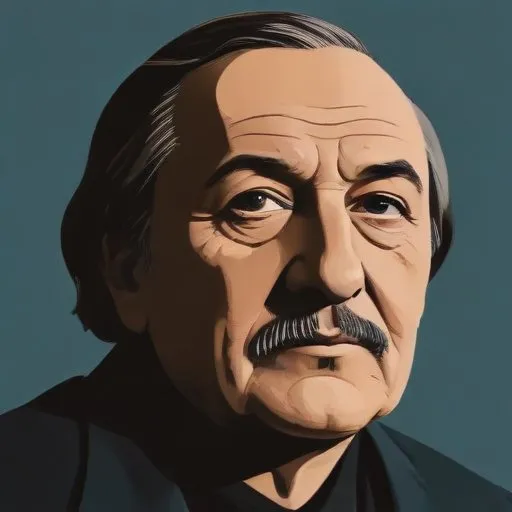
A German artist who created emotive sculptures and plays that explored the human condition, often focusing on themes of war, morality, and social justice.
Ernst Barlach was a German expressionist sculptor, medallist, printmaker, and writer, renowned for his powerful anti-war sculptures that protested the brutality of World War I. His provocative works, often considered "degenerate art" by the Nazi Party, continue to inspire and disturb audiences to this day.
Born on January 2, 1870, in Wedel, Holstein, Kingdom of Prussia, Barlach was the oldest of four sons to Johanna Luise Barlach and Dr. Georg Barlach. His early childhood was spent in Schnberg, Mecklenburg, where his father practiced medicine. After his father's death in 1884, the family returned to Schnberg, where Barlach attended secondary school.
Barlach's artistic talent was evident early on. He studied at the Gewerbeschule Hamburg from 1888 to 1891 and later at the Knigliche Akademie der bildenden Knste zu Dresden (Royal Art School Dresden) under Robert Diez from 1891 to 1895. During this period, he created his first major sculpture, Die Krautpflckerin (The Herb Plucker). He continued his studies in Paris at the Acadmie Julian from 1895 to 1897, where he developed a critical eye for the German tendency to emulate French art.
Barlach's work defied categorization, blending elements of Realism and Expressionism. His sculptures often featured elongated figures, rough textures, and distorted forms, conveying the emotional intensity and turmoil of the human experience. As a pacifist, he was deeply affected by the horrors of war, which became a recurring theme in his work.
Barlach's anti-war stance led to conflicts with the rising Nazi Party, which deemed his work "degenerate art." Many of his sculptures were confiscated, and he was eventually prohibited from producing art. Despite this, Barlach continued to create, often in secret, producing some of his most powerful and poignant works during this period.
Barlach's work was deeply rooted in his philosophical convictions. He believed in the importance of individualism, creative freedom, and the power of art to critique society. His sculptures often served as a form of political protest, challenging the prevailing ideologies of his time.
Ernst Barlach's work continues to influence contemporary art and politics. His anti-war sculptures serve as a powerful reminder of the devastating consequences of conflict and the importance of promoting peace and humanity. Today, his works are housed in museums and galleries around the world, a testament to his enduring legacy as a champion of artistic freedom and human rights.
"Art is the only way to run away without leaving home."
"The artist is a worm that crawls out of the earth, looks around, and then crawls back into the earth."
Ernst Barlach's remarkable life and work serve as a testament to the power of art to challenge and inspire. Despite the challenges he faced, his legacy continues to influence generations of artists, activists, and thinkers.
Born in 1840
A French sculptor and illustrator famous for creating iconic, emotionally charged figures that capture the human experience, including the iconic symbol of intellectualism, The Thinker.
Born in 1867
A pioneering Expressionist artist, known for vibrant, emotive paintings and prints that explored the human condition, often with a focus on spirituality and the natural world.
Born in 1880
A German soldier-turned-painter who pioneered Expressionism, capturing the emotional essence of animals and landscapes in vibrant, abstracted forms. His work continues to inspire artists and art lovers alike.
Born in 1866
A pioneer of abstract art, creating vibrant, expressive works that explored the emotional and spiritual properties of color, and wrote extensively on art theory.
Born in 1879
A Swiss-German artist and educator who blended fantasy and reality in his vibrant, whimsical paintings, exploring the emotional and expressive qualities of color. His unique style has inspired generations of artists.
Born in 1886
Austrian-Swiss artist who pioneered Expressionism through vibrant, emotive paintings and plays that explored the human condition. His works often featured distorted forms and bold colors.
Born in 1890
Austrian soldier and painter who captured the intensity of human emotion through bold, expressive portraits and landscapes, often exploring themes of death, sexuality, and the human condition.
