


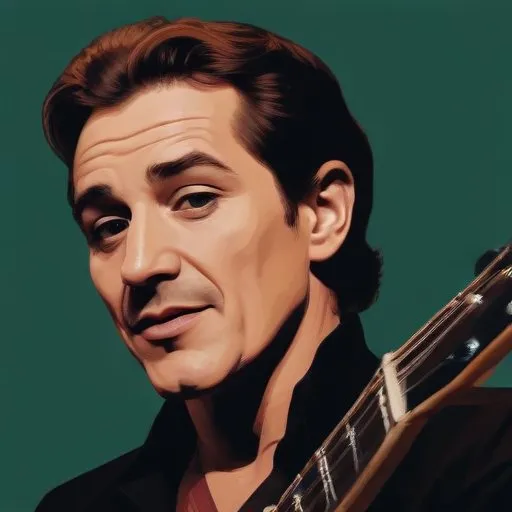
A popular Austrian singer, guitarist, and actor known for his rugged, wanderer image and hit songs like "Heimweh" and "Die Gitarre und das Meer". He's a German-speaking world icon, with a career spanning over 60 years.
Freddy Quinn, born Franz Eugen Helmut Manfred Nidl, is an Austrian singer and actor who soared to fame in the late 1950s and 1960s with his unique blend of Schlager music and wanderlust persona. With a career spanning over five decades, Quinn became synonymous with the image of the rootless wanderer, often drawing comparisons with Hans Albers, a legendary German actor and singer.
Quinn's early life was marked by international exposure, with his Irish-born salesman father, Johann Quinn, and Austrian journalist mother, Edith Henriette Nidl. He spent his childhood in Morgantown, West Virginia, and later moved back to Vienna with his mother. Through his mother's second marriage, Quinn adopted the name Nidl-Petz.
At the end of World War II, Quinn found himself as part of a refugee group, where he encountered American troops in Bohemia. Fluently speaking English, the 14-year-old Quinn pretended to be of American nationality, leading to his relocation to the US in May 1945. However, on Ellis Island, he discovered his father's tragic death in a car accident in 1943, and was sent back to Europe.
After a year-long stay in an Antwerp children's home, where he learned to speak French and Dutch, Quinn eventually headed to Germany. It was in St. Pauli, Hamburg, that he was discovered and offered his first recording contract in 1954. Quinn went on to represent Germany at the Eurovision Song Contest 1956 in Lugano, Switzerland, with the song "So geht das jede Nacht," although he did not win.
Quinn's music and persona reflected his philosophical take on life, shaped by his experiences as a wanderer and an outsider. His songs often spoke of the longing for a home, family, and friends, resonating with the post-war German audience. Quinn's music became synonymous with the Schlager scene, a genre that celebrated nostalgia and sentimentality.
Quinn's most popular songs include "Heimweh," "Jeder braucht jeden Tag ein bisschen Liebe," and "Vaya con Dios." His music often incorporated elements of folk, swing, and jazz, making him a unique figure in the Schlager scene. Quinn has released over 30 albums and has appeared in numerous films and television shows.
Freddy Quinn's impact on modern society extends beyond his music. He has inspired generations of German-speaking artists, including the likes of Udo Jürgens and Reinhard Mey. Quinn's persona of the wanderer has also influenced the German concept of "Heimat" (homeland), reflecting the country's complex relationship with its own identity.
Quinn has received numerous awards and honors for his contributions to music and entertainment. These include the prestigious Golden Camera award, the Bambi award, and the Echo award. He has also been honored with the title of "Kammersänger" (Chamber Singer) by the Austrian government.
Freddy Quinn's remarkable career has left an indelible mark on the German-speaking music scene. As a cultural icon, he has inspired generations of artists, and his music continues to evoke a sense of nostalgia and longing. Quinn's legacy serves as a testament to the power of music to transcend borders and generations, solidifying his place as one of the most beloved and enduring figures in German entertainment history.
Born in 1902
A renowned German actor, celebrated for his versatility in playing a wide range of roles, from comedy to drama, in numerous films and stage productions.
Born in 1907
A Swedish actress and singer who captivated audiences with her powerful voice and iconic film roles, becoming a beloved star of German cinema during the 1930s and 1940s.
Born in 1922
Austrian-German actor renowned for his intense, brooding performances in films like "Interlude" and "Ship of Fools", earning him an Academy Award nomination.
88 Years Old
A German-French actress who captivated audiences with her striking beauty and nuanced performances in films like "Sissi" and "Ludwig," earning her a lasting legacy in European cinema.
