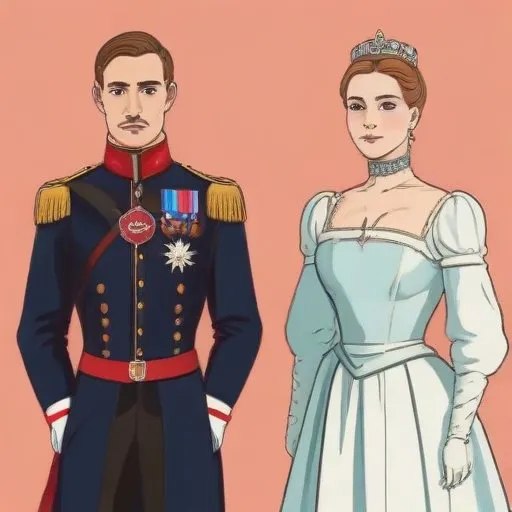
A Soldier, a Statesman, and a Family Man: Frederick II Eugene, Duke of Wurttemberg
Frederick II Eugene, Duke of Wurttemberg, is best known for his military prowess, serving under Frederick the Great during the Seven Years' War, and later becoming the reigning Duke of Wurttemberg from 1795 until his death in 1797.
Early Life and Military Career
Born on January 21, 1732, in Stuttgart, Frederick was the fourth son of Karl Alexander, Duke of Wurttemberg, and Princess Maria Augusta of Thurn and Taxis. He followed in the footsteps of his family's military tradition, serving under the great Frederick the Great during the Seven Years' War.
A Life of Service and Governorship
After his military service, Frederick took up residence in 1769 at his family's exclave, the County of Montbliard, where he was made lieutenant general in 1786 by his eldest brother, Charles Eugene, Duke of Wurttemberg. He later became the governor of the margraviate of Ansbach-Bayreuth by King Frederick William II of Prussia in 1791.
Rise to Power and Treaty of Paris
After the death of his brothers, Charles Eugene and Ludwig Eugen, Frederick became the reigning Duke of Wurttemberg in 1793. He played a significant role in shaping the fate of his duchy by acquiescing to the Treaty of Paris in 1796, which recognized the integrity of Wurttemberg while renouncing claims to territories on the left bank of the Rhine River.
Family and Legacy
Frederick married Friederike Sophia Dorothea of Brandenburg-Schwedt, a niece of Frederick the Great, and had twelve children with her. His eldest son, Frederick I, would later become the first King of Wurttemberg.
Personal Milestones and Key Life Events
- 1732: Born on January 21st in Stuttgart
- 1769: Took up residence at the County of Montbliard
- 1786: Made lieutenant general by his brother Charles Eugene
- 1791: Became governor of the margraviate of Ansbach-Bayreuth
- 1793: Became reigning Duke of Wurttemberg
- 1796: Signed the Treaty of Paris
- 1797: Passed away on December 23rd
Influence on Modern Society
Frederick's legacy extends beyond his military and political achievements. He played a significant role in shaping the history of Wurttemberg and its people, paving the way for future generations to build upon.
Fun Facts and Trivia
- Frederick's family, the House of Wurttemberg, was one of the oldest and most prominent noble families in Germany.
- He bought the castle and lordship of Hochberg in 1779 but resold it to his brother in 1791.
FAQ
Who was Frederick II Eugene, Duke of Württemberg?
Frederick II Eugene, Duke of Württemberg was a German nobleman and military leader who played a key role in the Seven Years War. He was the son of Karl Alexander, Duke of Württemberg, and Princess Maria Augusta of Thurn and Taxis.
What was Frederick II Eugenes role in the Seven Years War?
Frederick II Eugene fought on the side of the Prussians during the Seven Years War, distinguishing himself in several battles. His military skills and strategic thinking earned him the respect of Frederick the Great.
How did Frederick II Eugene modernize the Württemberg army?
Frederick II Eugene modernized the Württemberg army by introducing new tactics, training methods, and equipment. He also established a more efficient system of military administration, which improved the armys overall effectiveness.
What was Frederick II Eugenes relationship with Frederick the Great?
Frederick II Eugene and Frederick the Great shared a close and trusting relationship, despite being from different noble families. They worked together to achieve strategic objectives during the Seven Years War.
What is Frederick II Eugenes legacy in German history?
Frederick II Eugenes legacy lies in his military prowess and his role in shaping the course of the Seven Years War. He remains an important figure in German history, known for his bravery, strategic thinking, and loyalty to his allies.