


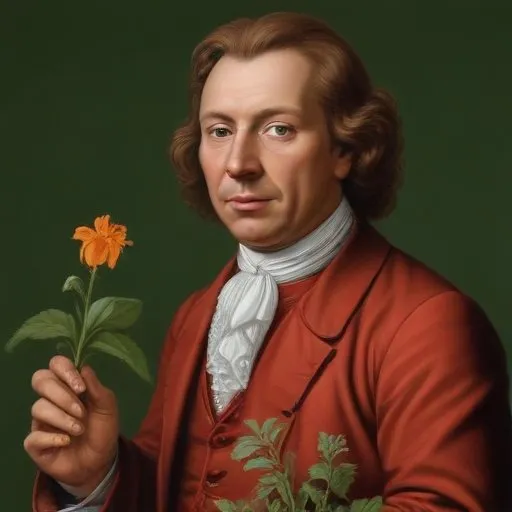
A 17th-century Dutch botanist and anatomist who made significant contributions to the field of anatomy, particularly in the study of human cadavers, and created detailed wax models of human organs. They are also known for their work in botany, discovering several plant species.
Frederik Ruysch, a Dutch botanist and anatomist, is renowned for his groundbreaking techniques in preserving anatomical specimens, which he used to create intricate dioramas incorporating human parts. These extraordinary specimens, numbering over 2,000, showcase his innovative methods of drying and embalming, allowing for the meticulous preservation of anatomical, pathological, zoological, and botanical samples.
Born on March 28, 1638, in The Hague, Ruysch was the son of a government functionary. Initially, he studied as the pupil of a druggist, but his fascination with anatomy led him to the University of Leiden, where he studied under the tutelage of Franciscus Sylvius. Among his fellow students were prominent figures such as Jan Swammerdam, Reinier de Graaf, and Niels Stensen.
Ruysch's innovative approaches to anatomical preservation enabled him to make significant discoveries in the field. He is credited with the proof of valves in the lymphatic system, the vomeronasal organ in snakes, and the arteria centralis oculi (central artery of the eye). Furthermore, he was the first to describe several diseases, including Hirschsprung's disease, intracranial teratoma, enchondromatosis, and Majewski syndrome.
Ruysch's expertise in anatomy led to his appointment as praelector of the Amsterdam surgeons' guild in 1667. He was also made the chief instructor to the city's midwives in 1668, ensuring that they underwent examination by him before practicing their profession. In 1679, he became a forensic advisor to the Amsterdam courts, and in 1685, he was appointed professor of botany at the Hortus Botanicus Amsterdam, where he collaborated with Jan and Caspar Commelin.
Ruysch's groundbreaking work in anatomical preservation and his discoveries in anatomy and physiology had a profound impact on the scientific community. His techniques and findings paved the way for future generations of researchers and scientists. Today, his work remains an essential part of the history of anatomy and physiology, inspiring continued exploration and discovery.
In 1661, Ruysch married Maria Post, daughter of the Dutch architect Pieter Post. He graduated from the University of Leiden in 1664 with a thesis on pleuritis. Throughout his life, Ruysch remained dedicated to his work, making significant contributions to the field of anatomy and beyond.
Frederik Ruysch's extraordinary life and work continue to inspire awe and fascination, offering a glimpse into the fascinating world of anatomy and the human body.
Born in 1526
A Flemish botanist and academic who introduced exotic plants to European gardens and wrote influential botanical books, laying the foundation for modern botany.
Born in 1516
A 16th-century Renaissance polymath who cataloged and described thousands of plants and animals, laying the foundations for modern taxonomy and zoology.
Born in 1522
A 16th-century Renaissance scholar who cataloged and described numerous plant and bird species, laying the foundation for modern taxonomy and ornithology. His work remains a valuable resource for scientists today.
Born in 1560
A 16th-century Swiss botanist, physician, and academic who cataloged over 6,000 plant species, laying the foundation for modern botanical taxonomy. His work, "Pinax Theatri Botanici", remains a seminal reference in the field.
