


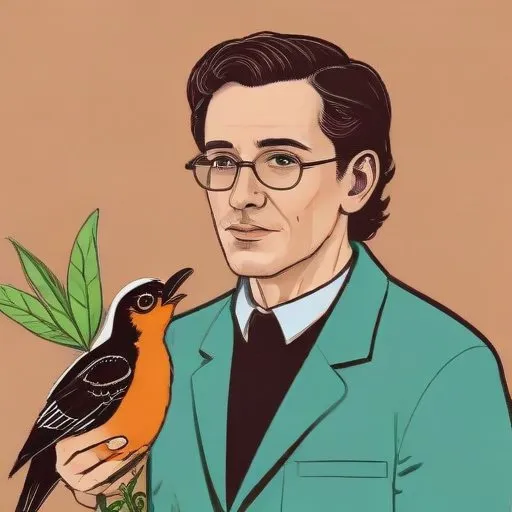
A 16th-century Renaissance scholar who cataloged and described numerous plant and bird species, laying the foundation for modern taxonomy and ornithology. His work remains a valuable resource for scientists today.
Ulisse Aldrovandi, a renowned Italian naturalist, is widely regarded as the father of natural history studies. His groundbreaking work in botany, zoology, and geology paved the way for future generations of scientists, earning him the respect of prominent figures like Carl Linnaeus and the Comte de Buffon.
Born on September 11, 1522, in Bologna, Italy, Aldrovandi came from a noble but impoverished family. His father, Teseo Aldrovandi, was a lawyer and Secretary to the Senate of Bologna, but died when Ulisse was just seven years old. His widowed mother wanted him to become a jurist, but Aldrovandi's interests lay elsewhere.
Initially, he was apprenticed to merchants as a scribe, but soon pursued studies in mathematics, Latin, law, and philosophy at the University of Bologna and later at the University of Padua in 1545. He became a notary, but his true passions lay in philosophy, logic, and medicine.
In June 1549, Aldrovandi was accused of heresy due to his alleged support for the antitrinitarian beliefs of the Anabaptist Camillo Renato. He was arrested and spent several months in custody or under house arrest. However, during this time, he befriended many local scholars and developed a deeper interest in botany, zoology, and geology.
After publicly abjuring his supposed heresy in September 1549, Aldrovandi was absolved in April 1550. This experience seemed to propel him towards his true calling, as he went on to organize numerous expeditions to the Italian mountains, countryside, islands, and coasts to collect and catalogue plants.
Aldrovandi obtained a degree in medicine and philosophy in 1553 and began teaching logic and philosophy in 1554 at the University of Bologna. He became professor of philosophy in 1559 and eventually the first professor of natural sciences at Bologna in 1561. This marked the beginning of a new era in natural history studies.
His work in botany led to the establishment of Bologna's botanical garden, one of the first in Europe. He is also credited with coining the term "geology." Aldrovandi's meticulous documentation and classification of plants and animals laid the foundation for modern taxonomy and natural history.
Aldrovandi's work was characterized by a deep curiosity and a desire to understand the natural world. He believed in the importance of empirical observation and experimentation, which set him apart from many of his contemporaries.
His philosophical contributions extended beyond the realm of natural history, as he explored the relationships between philosophy, logic, and medicine. Aldrovandi's work serves as a testament to the power of human curiosity and the importance of interdisciplinary approaches to knowledge.
Aldrovandi's legacy extends far beyond his own lifetime. His work laid the groundwork for subsequent generations of scientists, including Carl Linnaeus, who would go on to develop the modern taxonomic system.
Today, Aldrovandi's contributions to natural history, botany, and geology continue to inspire scientists, researchers, and enthusiasts alike. His commitment to empirical observation, experimentation, and documentation serves as a model for scientific inquiry and discovery.
As we reflect on the life and work of Ulisse Aldrovandi, we are reminded of the profound impact that one person can have on the course of human knowledge and understanding.
Born in 1519
A 16th-century Italian Renaissance figure who made significant contributions to the fields of philosophy, medicine, and botany, particularly in the classification of plants. He's also known for his work on the circulation of blood.
Born in 1751
Austrian pianist and composer known for his contributions to the development of the Classical piano concerto, leaving behind a legacy of over 100 concertos. His music showcases a unique blend of Viennese elegance and Bohemian flair.
Born in 1744
A French soldier, biologist, and academic who developed a theory of inheritance of acquired characteristics, proposing that organisms adapt to their environment and pass on those traits to their offspring.
Born in 1707
Developed the system of binomial nomenclature, which is still used today to classify and name living organisms. This system has had a profound impact on the fields of biology, ecology, and conservation.
82 Years Old
A German-Canadian singer-songwriter, guitarist, and producer, known for his eclectic style blending rock, folk, and blues, and as the frontman of the rock band Steppenwolf. He's famous for hits like "Born to Be Wild" and "Magic Carpet Ride".
Born in 1635
Pioneering researcher of birds and fish, credited with developing a systematic approach to classification and description of species. His work laid the foundation for modern ornithology and ichthyology.
