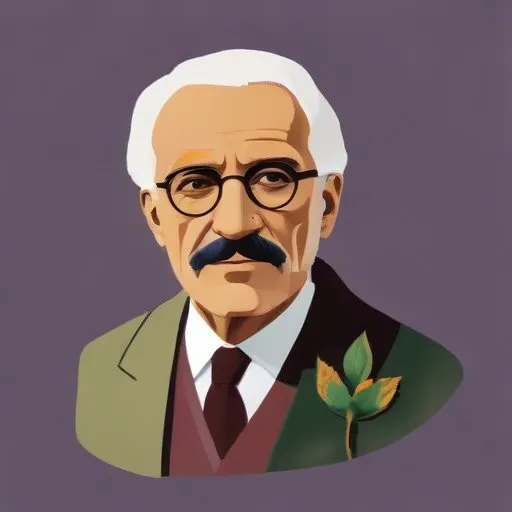
Andrea Cesalpino: The Renaissance Polymath Who Shaped the Course of Botany and Medicine
Andrea Cesalpino, a Florentine physician, philosopher, and botanist, is renowned for his groundbreaking contributions to the fields of botany, medicine, and philosophy. He is credited with classifying plants according to their fruits and seeds, rather than alphabetically or by medicinal properties, a pioneering approach that laid the foundation for modern botanical classification.
A Life of Learning and Exploration
Born in Arezzo, Tuscany, in the autumn of 1524, Cesalpino was drawn to the world of learning from a young age. He studied medicine and botany at the University of Pisa, under the tutelage of esteemed instructors R. Colombo and Luca Ghini. After completing his course, he went on to teach philosophy, medicine, and botany at the same university, while also conducting botanical explorations throughout Italy.
A New Era in Botany
Cesalpino's most significant contribution to botany was his innovative method of plant classification. By focusing on the fruits and seeds of plants, he was able to identify and categorize species more accurately than his predecessors. This approach, which was a departure from the traditional alphabetical or medicinal property-based classification, paved the way for future botanists to build upon.
The Botanical Gardens of Pisa and Rome
In 1555, Cesalpino succeeded Luca Ghini as the director of the botanical garden in Pisa, a position he held until 1558. During his tenure, he oversaw the expansion and development of the garden, which became a hub for botanical research and discovery. Later, in Rome, he became the professor of medicine at the University of Rome La Sapienza and physician to
Pope Clement VIII. He was also believed to have been the chief superintendent of the Roman botanical garden, which was established by his student,
Michele Mercati, around 1566.
Philosophical Contributions and Beliefs
Cesalpino's philosophical pursuits extended beyond the realm of botany and medicine. He was a proponent of Aristotelian philosophy and believed in the concept of chemical circulation in the human body. This idea, which posited that blood was composed of fluid and solid parts that underwent a process of evaporation and condensation, was a precursor to
William Harvey's later discovery of the circulatory system.
Legacy and Influence
Andrea Cesalpino's contributions to the fields of botany, medicine, and philosophy have left an indelible mark on the scientific community. His innovative approaches to plant classification, his role in establishing some of Europe's earliest botanical gardens, and his philosophical ideas about the human body have inspired generations of scholars and researchers. As a testament to his enduring legacy, Cesalpino's work continues to influence modern botanical and medical research.
Notable Students and Contemporaries
- Pietro Castelli, a prominent botanist, was one of Cesalpino's students.
- Michele Mercati, who established the Roman botanical garden, was another notable student.
- Cesalpino's contemporaries included Luca Ghini, R. Colombo, and William Harvey.
Personal Milestones and Key Life Events
- 1524: Born in Arezzo, Tuscany.
- 1555: Became the director of the botanical garden in Pisa.
- 1558: Left Pisa to teach philosophy, medicine, and botany at the University of Rome La Sapienza.
- 23 February 1603: Passed away in Rome.
Andrea Cesalpino's remarkable life and achievements serve as a testament to the power of human curiosity and innovation. As a true Renaissance polymath, he embodied the spirit of intellectual exploration and discovery that defined his era.
FAQ
What was Andrea Cesalpinos contribution to botany?
Andrea Cesalpino was an Italian physician and botanist who made significant contributions to the field of botany. He published a book on botany, De Plantis, which described over 1,500 plant species and introduced a new system of plant classification.
What was Andrea Cesalpinos medical career like?
Andrea Cesalpino had a distinguished medical career, serving as the physician to Pope Clement VIII and later becoming the professor of medicine at the University of Rome. He was known for his expertise in pharmacology and wrote several works on the subject.
How did Andrea Cesalpinos work influence later botanists?
Andrea Cesalpinos work in botany had a significant impact on later botanists, including Carolus Linnaeus, who used Cesalpinos system of plant classification as a foundation for his own work.
What was Andrea Cesalpinos philosophical approach to science?
Andrea Cesalpino was a proponent of Aristotelian philosophy and applied its principles to his scientific work. He believed in the importance of observation and experimentation in the pursuit of knowledge.
What is Andrea Cesalpinos legacy in modern science?
Andrea Cesalpinos legacy in modern science is one of innovation and discovery. He is recognized as a pioneer in the fields of botany and pharmacology, and his work laid the groundwork for later advances in these fields.