


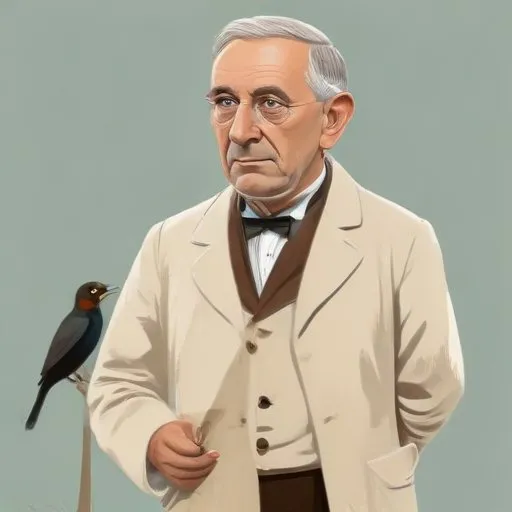
Pioneering researcher of birds and fish, credited with developing a systematic approach to classification and description of species. His work laid the foundation for modern ornithology and ichthyology.
Francis Willughby, a 17th-century English polymath, is renowned for his groundbreaking contributions to ornithology, ichthyology, mathematics, and linguistics. His pioneering work in these fields has left an indelible mark on the history of life sciences, making him a trailblazer of his time.
Born on November 22, 1635, at Middleton Hall, Warwickshire, Willughby was the only son of an affluent country family. He received his education at Trinity College, Cambridge, where he was tutored by the esteemed mathematician and naturalist, John Ray. This mentorship would prove instrumental in shaping Willughby's future endeavors.
Willughby, along with Ray and other prominent figures like John Wilkins, advocated for a novel approach to scientific study. They emphasized the importance of observation, classification, and experimentation, diverging from the traditional reliance on Aristotelian authority and biblical scripture. This paradigm shift paved the way for a more empirical and systematic understanding of the natural world.
To gather data and specimens, Willughby embarked on extensive journeys throughout England, Wales, and continental Europe. These expeditions allowed him to visit museums, libraries, and private collections, as well as study local flora and fauna. His travels fostered a deeper understanding of the natural world and provided valuable insights for his later works.
Willughby's most notable contributions include his work on ornithology, ichthyology, and mathematics. His Ornithologiae Libri Tres, published posthumously by John Ray, introduced innovative classification methods that would influence natural history writers for generations to come. Similarly, his Historia Piscium and Historia Insectorum set new standards for the study of fish and invertebrates.
In 1668, Willughby married Emma Barnard, with whom he had three children. Unfortunately, his life was cut short due to illness, and he succumbed to pleurisy in 1672, at the young age of 36. Despite his untimely passing, Willughby's legacy endures, with his works continuing to inspire and educate scientists and scholars alike.
Willughby's pioneering spirit and commitment to empirical research have had a lasting impact on the development of life sciences. His contributions to ornithology, ichthyology, and mathematics have paved the way for subsequent discoveries and advancements in these fields. As a testament to his enduring influence, Willughby's name remains synonymous with innovation and excellence in scientific inquiry.
Through his remarkable achievements, Francis Willughby has left an indelible mark on the annals of scientific history. His groundbreaking work continues to inspire and educate, serving as a testament to the power of human curiosity and intellectual pursuit.
82 Years Old
A German-Canadian singer-songwriter, guitarist, and producer, known for his eclectic style blending rock, folk, and blues, and as the frontman of the rock band Steppenwolf. He's famous for hits like "Born to Be Wild" and "Magic Carpet Ride".
Born in 1707
Developed the system of binomial nomenclature, which is still used today to classify and name living organisms. This system has had a profound impact on the fields of biology, ecology, and conservation.
Born in 1720
A pioneering naturalist who meticulously recorded and studied the behaviors of birds and other wildlife in their native habitats, laying the groundwork for modern ecology and conservation.
Born in 1766
A pioneering figure in American ornithology, credited with creating the first comprehensive guide to North American birds, featuring his own illustrations. His work remains a foundation for modern bird studies.
Born in 1785
A pioneering ornithologist and artist, famous for meticulously illustrating and documenting North American bird species in his iconic book "The Birds of America". His work remains a cornerstone of ornithology and wildlife art.
Born in 1810
A 19th-century British biologist who popularized marine biology through his writings and discoveries, particularly on sea anemones and crustaceans. His works inspired a new generation of naturalists.
Born in 1823
A pioneering naturalist who discovered evolution through natural selection, independently of Charles Darwin, and contributed significantly to the field of biogeography.
