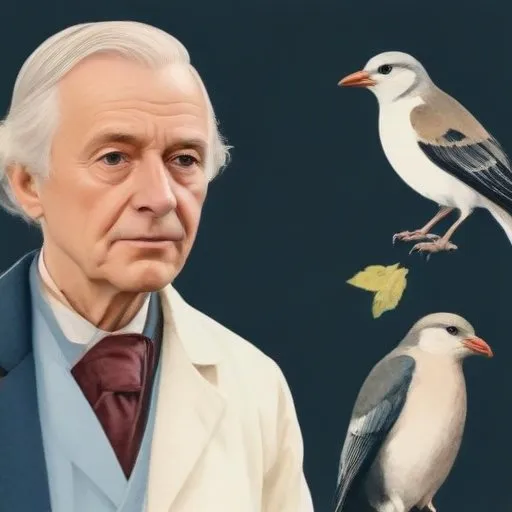
Gilbert White: The Pioneering Naturalist and Ornithologist
A Legacy in Natural History and Antiquities
Gilbert White is best known for his monumental work,
Natural History and Antiquities of Selborne, which has become a cornerstone of natural history and ecology. This pioneering English naturalist, ecologist, and ornithologist spent his life studying and documenting the natural world, leaving behind a rich legacy that continues to inspire scientists and nature enthusiasts alike.
Early Life and Education
Born on July 18, 1720, in Selborne, Hampshire, Gilbert White was the eldest of eight surviving siblings. His family lived briefly in Compton, Surrey, before moving to The Wakes in 1728, which would be his home for the rest of his life. White was educated in Basingstoke by
Thomas Warton, father of Joseph Warton and Thomas Warton, and later attended Oriel College, Oxford in December 1739. He took his degree as Bachelor of Arts in June 1743 and was elected fellow of the college in March 1744.
A Life of Service and Observation
White obtained his deacon's orders in 1746 and was fully ordained in 1749. He held several curacies in Hampshire and Wiltshire, including Selborne's neighboring parishes of Newton Valence and Farringdon, as well as Selborne itself on four separate occasions. In 1752-1753, White held the office of Junior Proctor at Oxford and was Dean of Oriel. He became non-resident perpetual curate of Moreton Pinkney in Northamptonshire in 1757. After the death of his father in 1758, White moved back into the family home at The Wakes in Selborne, which he eventually inherited in 1763. In 1784, he became curate of Selborne for the fourth time, remaining so until his death.
A Passion for Observation and Recording
Gilbert White's passion for observation and recording the natural world is evident in his
Natural History and Antiquities of Selborne. This groundbreaking work is a testament to his meticulous attention to detail and his ability to observe and record the intricacies of nature. White's work laid the foundation for modern ecology and ornithology, influencing generations of scientists and naturalists.
A Lasting Legacy
Gilbert White's legacy extends far beyond his written work. He was a pioneer in the field of natural history, and his contributions to the study of ecology and ornithology continue to inspire and inform scientists today. His commitment to observation, recording, and documentation has left a lasting impact on our understanding of the natural world.
- Natural History and Antiquities of Selborne has been translated into numerous languages and remains a classic in the field of natural history.
- White's work has inspired generations of naturalists, including Charles Darwin and Alfred Russel Wallace.
- His observations on the behavior of birds and other animals have contributed significantly to our understanding of ecology and conservation.
A Life of Quiet Devotion
Gilbert White's life was marked by a quiet devotion to his work and a deep love for the natural world. He lived a simple life, content in his pursuits and observations, leaving behind a legacy that continues to enrich our understanding of the world around us.
FAQ
What is Gilbert White known for in ornithology?
Gilbert White is known for his pioneering work in ornithology, particularly his detailed observations of birds and their behavior, as recorded in his book The Natural History of Selborne. He is considered one of the founders of modern ornithology. Sub-question: What is The Natural History of Selborne about?
What was Gilbert Whites contribution to ecology?
Gilbert Whites work laid the foundation for modern ecology. He was one of the first scientists to study the relationship between living organisms and their environment, and his observations on the interconnectedness of species and their habitats helped shape the field of ecology.
Where did Gilbert White live and work?
Gilbert White lived and worked in Selborne, Hampshire, England. His home, The Wakes, is now a museum dedicated to his life and work.
What is Gilbert Whites legacy in science?
Gilbert Whites legacy in science is that of a pioneer in ornithology and ecology. His work has inspired generations of naturalists and scientists, and his book The Natural History of Selborne remains a classic in the field.
How did Gilbert Whites work influence later scientists?
Gilbert Whites work influenced later scientists such as Charles Darwin, who often referred to Whites observations in his own work. Whites emphasis on detailed observation and recording of natural phenomena has also inspired many other scientists in the fields of ornithology and ecology.