


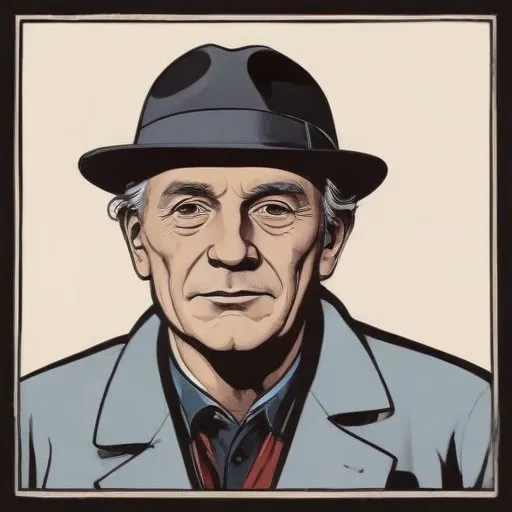
A German geographer and ethnologist who developed the theory of Kulturkreis, or "culture circles," which posits that cultures evolve through a series of stages. He's known for his work on cultural diffusion and the migration of people.
Fritz Graebner, a German geographer and ethnologist, is renowned for developing the theory of Kulturkreis, or culture circle, which revolutionized the field of ethnology. His groundbreaking concept, which posits that cultures diffuse and evolve through geographical migration and contact, earned him recognition as the first theoretician of the Vienna School of Ethnology.
Graebner's fascination with cultural diffusion began during his early years as a geographer. He noticed that similar cultural practices and artifacts appeared in disparate regions, sparking his curiosity about the migratory patterns of humans and the transmission of cultural knowledge. This observation led him to formulate the Kulturkreis theory, which posits that cultures originate from a common center and spread through migration, trade, and other forms of human interaction.
Graebner's work in Oceania, particularly in Australia, led to the identification of six primeval culture complexes. These complexes, described in his book Ethnologie, include Tasmanian culture, Old Australian boomerang culture, Totemic hunter culture, Moitey complex two-class horticulturists culture, Melanesian bow culture, and Polynesian patrilineal culture. This pioneering work shed light on the region's rich cultural heritage and highlighted the significance of understanding cultural evolution.
Born in Berlin in 1877, Graebner pursued his academic endeavors with zeal. He traveled extensively, attending conferences and conducting fieldwork. However, his life took an unexpected turn when World War I broke out in 1914. Attending an anthropological conference in Australia at the time, he was accused of hiding sensitive documents and was not allowed to leave the country for the duration of the war.
Graebner's publications include Methode der Ethnologie (Method of Ethnology, 1911) and Das Weltbild der Primitiven (The World View of the Primitives, 1924). His work influenced prominent ethnologists like Franz Boas, Clark Wissler, and Paul Kirchhoff, leaving an indelible mark on the field of ethnology.
Fritz Graebner's contributions to ethnology have left a lasting legacy. His theory of Kulturkreis has inspired generations of scholars, shaping the study of cultural evolution and diffusion. As a pioneer in his field, Graebner's work continues to inform and inspire research in ethnology, geography, and cultural anthropology.
Fritz Graebner's remarkable journey, marked by intellectual curiosity and a passion for cultural understanding, has left an enduring impact on the world of ethnology. His groundbreaking theories and contributions continue to inspire scholars, ensuring his legacy as a pioneer in the field.
Born in 1833
A renowned geographer and academic who pioneered the field of geomorphology, mapping and describing the Earth's landforms and landscapes. He's credited with coining the term "Silk Road" to describe the ancient trade routes between Europe and Asia.
Born in 1779
Founded the modern academic field of geography, emphasizing the importance of human-environment interactions and cultural differences in shaping the world around us.
Born in 1769
A pioneering geographer and explorer who mapped much of South America and discovered the Caspian Sea's connection to the Black Sea, greatly advancing our understanding of the natural world.
Born in 1777
A pioneer in mathematics and physics, he made major contributions to number theory, algebra, and electromagnetism, shaping our understanding of the natural world.
Born in 1880
A German meteorologist and geophysicist who proposed the theory of continental drift, suggesting that the Earth's continents were once joined together in a single supercontinent. This revolutionary idea transformed our understanding of the Earth's history and plate tectonics.
