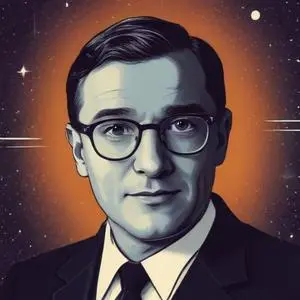
Fritz Zwicky: The Visionary Astronomer Who Saw Beyond the Stars
Theorizing the Invisible: Dark Matter and Zwicky's Legacy
Fritz Zwicky is renowned for being the first to propose the existence of dark matter, a concept that revolutionized our understanding of the universe. In 1933, he applied the virial theorem to galaxy clusters, revealing the presence of unseen mass, which he dubbed "dunkle Materie" or dark matter.
Early Life and Education
Born on February 14, 1898, in Varna, Bulgaria, to a Swiss father and Czech mother, Zwicky's fascination with math and physics began at a tender age. He was sent to his paternal grandparents in Glarus, Switzerland, at the age of six to study commerce, but his interests soon shifted to math and physics. Zwicky pursued his passion at the Swiss Federal Polytechnic (now ETH Zurich), where he earned his Dr. sc. nat. degree in 1922 with a thesis on the theory of heteropolar crystals.
A New Chapter in the United States
In 1925, Zwicky emigrated to the United States, securing a Rockefeller Foundation fellowship to work with Robert Millikan at California Institute of Technology (Caltech). This marked the beginning of a fruitful career that would span decades. Zwicky's office was conveniently located down the hall from Robert Oppenheimer, facilitating lively discussions and collaborations.
Cosmological Theories and Contributions
Zwicky's work at Caltech led to numerous groundbreaking contributions:
- Tidal forces and galaxy interactions: Zwicky introduced the concept of tidal forces in galaxy interactions, demonstrating how they could distort galaxy shapes.
- Supernovae and cosmic rays: He proposed that supernovae were capable of accelerating cosmic rays, a theory later supported by observations.
- Morphological classification of galaxies: Zwicky developed a comprehensive system for classifying galaxies based on their morphology.
Awards and Honors
Zwicky received numerous accolades for his work, including:
- Gold Medal of the Royal Astronomical Society (1949)
- Henry Draper Medal of the National Academy of Sciences (1949)
- Presidential Medal of Freedom (1949)
Personal Life and Legacy
Zwicky's personal life was marked by a strong sense of family and loyalty. His father, Fridolin, was a prominent industrialist and ambassador of Norway in Varna, while his sister, Leonie, married a Bulgarian and spent her life in Varna. Zwicky's own life was characterized by a fierce dedication to his work, earning him the respect and admiration of his peers.
Impact on Modern Astronomy
Fritz Zwicky's pioneering work on dark matter, cosmological theories, and galaxy interactions has left an indelible mark on modern astronomy. His theories continue to influence our understanding of the universe, inspiring new generations of astronomers and physicists. As we continue to explore the mysteries of the cosmos, Zwicky's legacy serves as a beacon, guiding us toward the unseen and the unknown.
FAQ
What was Fritz Zwickys role in astrophysics?
Fritz Zwicky was a Swiss-American physicist and astronomer who made significant contributions to our understanding of the universe, including the discovery of dark matter and neutron stars.
What were some of Fritz Zwickys notable scientific contributions?
Fritz Zwickys contributions include his work on supernovae, galaxy clusters, and the discovery of dark matter. He was also a pioneer in the field of neutron star research and astrophysical cosmology.
How did Fritz Zwicky influence 20th-century astrophysics?
Fritz Zwickys work had a profound impact on 20th-century astrophysics, shaping our understanding of the universe and inspiring new areas of research. He was a true pioneer in the field.
What was Fritz Zwickys relationship like with other scientists?
Fritz Zwicky was known for his intense personality and strong opinions, which sometimes led to controversies with other scientists. However, he was also a respected and admired figure in the scientific community.
What is Fritz Zwickys legacy in astrophysics and cosmology?
Fritz Zwickys legacy is that of a visionary scientist who expanded our understanding of the universe. His work continues to inspire and influence astrophysicists and cosmologists around the world.