


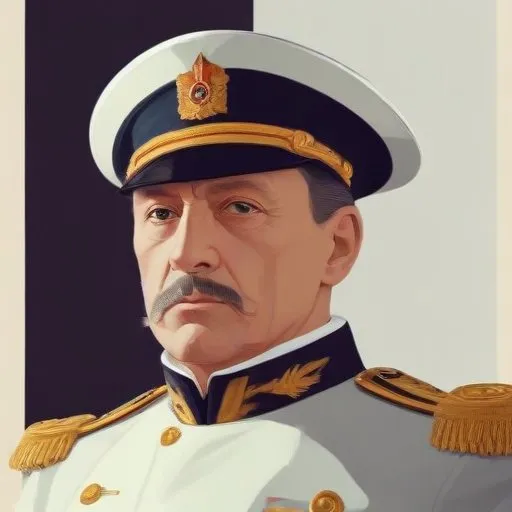
Russian naval commander who led the Baltic Fleet during the Great Northern War, achieving several victories and playing a key role in Peter the Great's military reforms.
Fyodor Apraksin, also known as Apraxin, was a prominent Russian admiral, governor, and statesman who played a pivotal role in establishing Russia's naval dominance during the early 18th century. He is renowned for his exceptional leadership, innovative shipbuilding techniques, and strategic military victories that catapulted Russia to become a major European power.
Born on December 7, 1661, in Moscow, Apraksin's family rose to prominence after his sister Marfa married Tsar Feodor III of Russia in 1681. He began his service as a stolnik (a high-ranking noble) at the age of 10, serving his brother-in-law and later the young Tsar Peter. Apraksin's early years were marked by his involvement in military amusements and the construction of a toy flotilla for the young tsar, forging a lifelong friendship between the two.
In 1692, Apraksin was appointed governor of Arkhangelsk, Russia's primary trade port, where he commissioned one of the country's first trade vessels to sail abroad. His exceptional leadership and innovative shipbuilding techniques caught the attention of Tsar Peter, who entrusted him with major shipbuilding activities in Voronezh in 1697. Apraksin's accomplishments in Voronezh led to his appointment as the first Russian governor of Azov in 1700.
Apraksin's most notable achievements came during the Great Northern War. He was appointed commander of the Baltic Fleet in 1723 and played a crucial role in the construction of fleets, fortresses, and havens in South Russia. His technical expertise and strategic prowess helped Russia secure key victories, earning him the rank of general admiral in 1708.
Apraksin's vision and leadership transformed Russia's naval power, paving the way for the country's emergence as a major European power. He was an early advocate for modernizing Russia's naval fleet and introduced innovative shipbuilding techniques. His legacy extends beyond his military achievements, as he also governed Estonia and Karelia from 1712 to 1723 and presided over the Russian Admiralty from 1717 to 1728.
Apraksin's lifelong friendship with Tsar Peter, forged during their childhood, was a defining aspect of his life. He remained loyal to the tsar throughout his reign and served as a trusted advisor. Apraksin's personal relationships were marked by his affinity for education and innovation, reflecting his commitment to modernizing Russia.
Fyodor Apraksin's remarkable career, marked by innovation, strategic vision, and loyalty, has left an indelible mark on Russia's history. His legacy continues to inspire generations of naval officers, statesmen, and entrepreneurs, solidifying his place as one of the most influential figures of the early 18th century.
Born in 1672
Reformed Russia's government, military, and culture, transforming it into a major European power. Known for modernizing and westernizing the country through numerous reforms and founding St. Petersburg.
Born in 1686
A Russian ethnographer and politician who compiled the first comprehensive history of Russia and developed the concept of Eurasia, shaping the country's national identity. He also founded several cities, including Stavropol and Yekaterinburg.
Born in 1686
Russian Minister of Foreign Affairs who played a crucial role in shaping Russia's foreign policy during the Napoleonic Wars, known for his diplomatic skills and ability to navigate complex international relations.
