


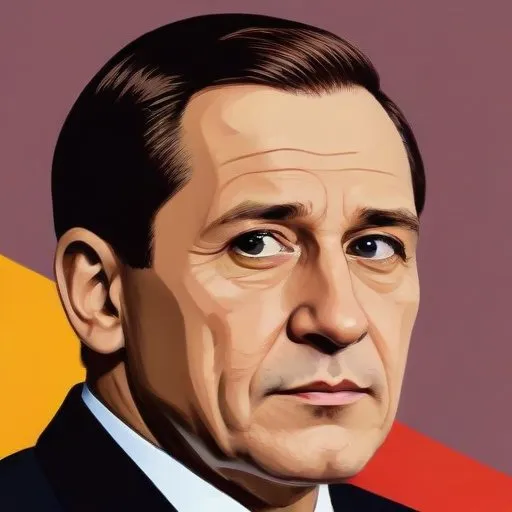
Russian Minister of Foreign Affairs who played a crucial role in shaping Russia's foreign policy during the Napoleonic Wars, known for his diplomatic skills and ability to navigate complex international relations.
Andrey Osterman, also known as Heinrich Johann Friedrich Ostermann, is renowned for his significant contributions to Russian politics and foreign policy during the early 18th century. As a trusted advisor to Tsar Peter I of Russia, Osterman played a crucial role in shaping the country's diplomatic relations with European nations, particularly Austria.
Born on June 9, 1686, in Bochum, Westphalia, to a middle-class Lutheran pastor, Osterman exhibited exceptional language skills from an early age. He pursued his passion for languages at the University of Jena, where he became proficient in German, Latin, French, Dutch, Italian, and Russian.
Osterman's linguistic expertise caught the attention of Vice-Admiral Cornelis Kruse, who introduced him to Tsar Peter I. Osterman soon became the right-hand man of Vice-Chancellor Shafirov, assisting him during the tumultuous negotiations that led to the Peace of the Pruth in 1711. His exceptional diplomatic skills and ability to navigate complex negotiations earned him a reputation as a shrewd and astute statesman.
Osterman's most notable achievement was concluding the Peace of Nystad with Sweden in 1721, for which he was created a baron. He also played a key role in negotiating a commercial treaty with Persia in 1723, which further solidified his position as a skilled diplomat.
Osterman introduced several administrative novelties during his tenure, including the Table of Ranks and the reconstruction of the College of Foreign Affairs on more modern lines. These reforms had a lasting impact on the Russian administrative system.
Osterman's legacy extends beyond his diplomatic achievements. He played a significant role in shaping Russia's foreign policy during the early 18th century, laying the foundation for the country's future diplomatic engagements. His administrative reforms also contributed to the modernization of the Russian state.
In conclusion, Andrey Osterman's remarkable career as a statesman, diplomat, and administrator has left an indelible mark on Russian history. His diplomatic achievements, administrative reforms, and personal milestones serve as a testament to his enduring legacy.
76 Years Old
Russia's top diplomat, responsible for shaping the country's foreign policy and representing its interests on the global stage, known for his sharp wit and tough negotiating style.
74 Years Old
A Russian politician who has dominated the country's politics for over two decades, known for his authoritarian leadership style and controversial foreign policy decisions.
61 Years Old
Russian lawyer and politician who served as President of Russia from 2008 to 2012, known for his efforts to modernize Russia's economy and politics. He also served as Prime Minister from 2012 to 2020.
95 Years Old
The last leader of the Soviet Union, who introduced reforms that led to the end of the Cold War and the collapse of communism, earning a Nobel Peace Prize. He's known for his policies of glasnost and perestroika, which transformed the Soviet Union and the world.
95 Years Old
First President of Russia, leading the country's transition from communism to democracy, and known for his bold reforms and iconic leadership style.
Born in 1870
Founder of the world's first socialist state, leading the Bolshevik Revolution and establishing the Soviet Union, known for his radical Marxist ideology and authoritarian rule.
Born in 1879
Founded the Red Army and played a crucial role in the Russian Revolution, shaping the course of modern communism. A key figure in 20th-century politics and ideology.
Born in 1878
The Soviet Union's ruthless leader who ruled with an iron fist, implementing policies that led to widespread famine and purges, while also playing a crucial role in defeating Nazi Germany in World War II.
