


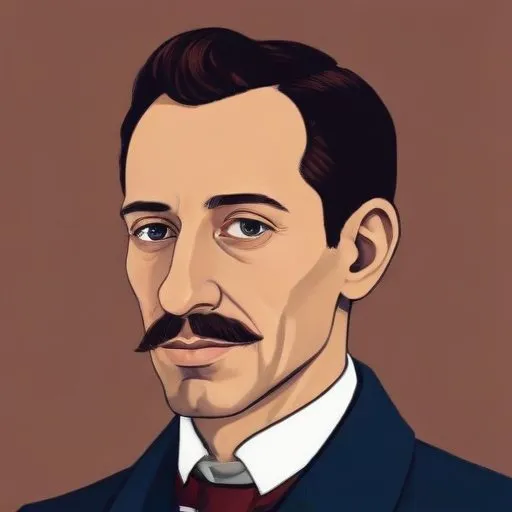
Developed descriptive geometry, a field that combines math and engineering to create precise drawings and models, revolutionizing architecture, engineering, and manufacturing.
Gaspard Monge, also known as the Comte de Pule, is widely recognized as the inventor of descriptive geometry, the mathematical basis of technical drawing, and the father of differential geometry. His groundbreaking work in these fields has had a profound impact on the development of modern mathematics, engineering, and architecture.
Monge was born on May 9, 1746, in Beaune, Côte-d'Or, France, to a merchant family. He received his education at the College of the Oratorians in Beaune and later at the Collège de la Trinité in Lyon, where he excelled in physics and mathematics.
Monge's early work on descriptive geometry led to the development of a new method of representation, which enabled the creation of accurate drawings and models of complex structures. His work in this field led to significant improvements in engineering and architecture, and he is often credited with inventing the art of technical drawing.
In 1764, Monge created a large-scale plan of his hometown, Beaune, which showcased his innovative methods of observation and instrument construction. This plan, still preserved in the town's library, caught the attention of an officer of engineers, who recommended Monge to the commandant of the École Royale du Génie at Mézières.
Monge's talent and expertise earned him a position as a draftsman at the École Royale du Génie, where he worked alongside Charles Bossut, a prominent mathematician. Although not allowed to attend the officer school due to his non-aristocratic background, Monge continued to develop his ideas in his spare time.
Monge was initiated into the L'Union parfaite lodge of Freemasonry, where he met like-minded individuals who shared his passion for mathematics and science. During the French Revolution, he played a key role in the reform of the French educational system, helping to found the École Polytechnique, an institution that would become a hub for scientific and mathematical innovation.
Monge's work has had a lasting impact on modern society, influencing the development of engineering, architecture, and mathematics. His contributions to descriptive geometry and differential geometry paved the way for advancements in fields such as computer-aided design (CAD) and geographic information systems (GIS).
Monge's achievements were recognized during his lifetime, and he was awarded numerous honors, including the title of Comte de Pule. He was also elected to the French Academy of Sciences in 1780.
Gaspard Monge's remarkable life and achievements serve as a testament to the power of innovation and dedication. His legacy continues to inspire mathematicians, engineers, and architects around the world, and his contributions to descriptive geometry and differential geometry remain a cornerstone of modern mathematics.
Born in 1749
Developed nebular hypothesis of the origin of the solar system and formulated Laplace's equation, a fundamental concept in mathematics and physics. He's considered the founder of celestial mechanics.
Born in 1736
Developed calculus, number theory, and celestial mechanics, making significant contributions to the fields of mathematics and astronomy.
Born in 1752
Developed the theory of elliptic integrals, and his work on number theory laid the foundation for modern cryptography.
Born in 1774
A French polymath who made significant contributions to the fields of physics, astronomy, and mathematics, particularly in the discovery of chromatic polarization and the Biot-Savart law.
Born in 1786
A mathematician and politician who made significant contributions to the development of electromagnetism and served as Prime Minister of France, advocating for social reform and education.
Born in 1789
Developed rigorous mathematical theories and introduced concepts like convergence and continuity, revolutionizing calculus and paving the way for modern mathematics.
Born in 1777
A pioneer in mathematics and physics, he made major contributions to number theory, algebra, and electromagnetism, shaping our understanding of the natural world.
