


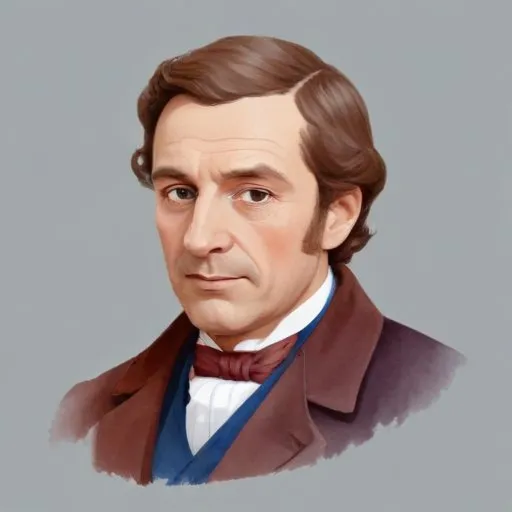
A 19th-century mathematician who made significant contributions to combinatorial mathematics, particularly in the field of graph theory, and is credited with being the first to solve the "Euler's 36 officers problem".
Gaston Tarry, a French mathematician, is renowned for his remarkable contributions to the field of mathematics, particularly in the realm of combinatorial designs. His most notable achievement is the confirmation of Leonhard Euler's conjecture that no 66 Graeco-Latin square was possible, resolving the famous "36 officers problem" in 1901.
Born on September 27, 1843, in Villefranche de Rouergue, Aveyron, France, Tarry's affinity for mathematics was evident from an early age. Despite pursuing a career in the civil service in Algeria, he continued to study mathematics as an amateur, driven by an insatiable passion for the subject.
In 1901, Tarry made history by confirming Euler's conjecture, which had gone unsolved for over a century. This groundbreaking achievement not only underscored Tarry's exceptional mathematical prowess but also earned him recognition within the mathematical community. The 36 officers problem, as it came to be known, was a complex puzzle that had stumped mathematicians for generations, and Tarry's solution marked a significant milestone in the field.
Tarry's mathematical contributions extended beyond the 36 officers problem. He is also credited with working on the Prouhet-Tarry-Escott problem, a mathematical puzzle involving the arrangement of integers in a square. Additionally, his work on tetramagic squares, a type of magic square with additional properties, demonstrated his remarkable skill in combinatorial mathematics.
Today, Tarry's name is synonymous with mathematical excellence. His work has influenced generations of mathematicians, and his contributions continue to inspire new breakthroughs in the field. As a testament to his legacy, the Tarry point, a concept in combinatorial design, bears his name. This lasting impact on the world of mathematics is a true reflection of Gaston Tarry's unwavering dedication to his craft.
Although Tarry's life was defined by his passion for mathematics, few records of his personal life exist. However, it is clear that his amateur pursuits in mathematics were driven by an insatiable curiosity and love for the subject. This singular focus earned him a place among the esteemed ranks of amateur mathematicians who have made significant contributions to the field.
Tarry's work may have been confined to the realm of pure mathematics, but its implications have far-reaching consequences. The principles underlying his work on combinatorial designs have influenced fields such as computer science, cryptography, and coding theory. As a result, his legacy extends beyond the confines of mathematics, impacting modern society in meaningful ways.
As we reflect on Gaston Tarry's remarkable life and contributions, we are reminded of the power of dedication and passion. His legacy serves as a beacon, inspiring future generations of mathematicians to pursue their dreams and push the boundaries of human knowledge.
Born in 1854
A pioneer in mathematics and physics, he laid the foundations for modern chaos theory, topology, and relativity, making groundbreaking contributions to our understanding of space and time.
Born in 1871
A French mathematician and politician who made significant contributions to probability theory, measure theory, and topology, and served as a minister in the French government.
Born in 1838
A 19th-century mathematician who made significant contributions to group theory, particularly in the development of the Jordan-Holder theorem, and was one of the first to introduce abstract algebraic concepts.
Born in 1749
Developed nebular hypothesis of the origin of the solar system and formulated Laplace's equation, a fundamental concept in mathematics and physics. He's considered the founder of celestial mechanics.
Born in 1736
Developed calculus, number theory, and celestial mechanics, making significant contributions to the fields of mathematics and astronomy.
Born in 1752
Developed the theory of elliptic integrals, and his work on number theory laid the foundation for modern cryptography.
Born in 1789
Developed rigorous mathematical theories and introduced concepts like convergence and continuity, revolutionizing calculus and paving the way for modern mathematics.
Born in 1826
A pioneering mathematician who developed the theory of higher dimensions and laid the foundations for modern physics, particularly in the understanding of space and time.
