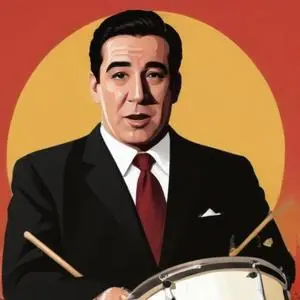
Gene Krupa: The Revolutionary Drummer Who Redefined Jazz
The Drumming Icon of the 20th Century
Gene Krupa, the American jazz drummer, bandleader, and composer, is widely regarded as one of the most influential drummers in the history of popular music. His iconic drum solo on
Benny Goodman's 1937 recording of "Sing, Sing, Sing" elevated the role of the drummer from an accompanist to a soloist, cementing his place in jazz history.
Early Life and Career
Born on January 15, 1909, in Chicago, Illinois, Krupa was the youngest of nine children to Anna and Bartomiej Krupa, Polish immigrants. Raised in a Catholic family, Krupa was initially groomed for the priesthood but instead pursued a career in music. He attended Saint Joseph's College for a year before dropping out to focus on drumming.
Early Influences and Collaborations
Krupa's early influences included Sanford A. Moeller, with whom he studied, and his work with
Thelma Terry and Her Playboys, one of the first notable American jazz bands led by a female musician. He made his first recordings in 1927 with this band and went on to play with prominent bands in Wisconsin.
The Standardization of the Drum Kit
In collaboration with Slingerland drum and Zildjian cymbal manufacturers, Krupa played a crucial role in defining the standard band drummer's kit. This partnership led to the development of modern drumming techniques and equipment, solidifying Krupa's position as a pioneer in the field.
The Legacy of "Sing, Sing, Sing"
Krupa's virtuosic drum solo on "Sing, Sing, Sing" redefined the role of the drummer in jazz. His frenzied, flashy drumming style elevated the drummer from an accompanist to a soloist, paving the way for future generations of drummers.
Awards and Honors
Krupa was posthumously inducted into the
DownBeat Jazz Hall of Fame in 1973 and the
Modern Drummer Hall of Fame in 1987. He received a
Grammy Lifetime Achievement Award in 2003.
Influence on Modern Society
Krupa's influence extends beyond jazz to rock, punk, and pop music. His revolutionary drumming style has inspired countless drummers, including
Tommy Aldridge,
Neil Peart, and
Dave Grohl. His legacy continues to shape the music industry today.
Personal Milestones and Key Life Events
- Krupa married Ethel McGuire in 1934, and they remained together until his death in 1973.
- He was arrested in 1943 for possession of marijuana and served 90 days in jail.
- Krupa made a comeback in the 1950s, performing with his own band and recording several albums.
Controversies and Public Perception
Krupa's personal struggles with addiction and his involvement in the 1943 marijuana scandal led to controversy and criticism. However, his contributions to jazz and drumming have ultimately overshadowed these setbacks, cementing his status as a musical icon.
Philosophical Contributions and Beliefs
Krupa's approach to drumming emphasized individuality, creativity, and experimentation. He believed that drumming should be a vital component of the music, rather than simply an accompaniment.
Historical Context and Legacy
Gene Krupa's life and legacy span a period of significant change in American music, from the swing era to the rise of rock 'n' roll. His influence on jazz and drumming continues to inspire new generations of musicians, ensuring his place in the pantheon of musical greats.
Fun Facts and Trivia
- Krupa was known for his flashy, attention-grabbing style, both on and off stage.
- He was a fixture on the Chicago jazz scene in the 1920s and 1930s.
- Krupa's drum solo on "Sing, Sing, Sing" has been inducted into the Grammy Hall of Fame.
Quotes and Memorable Sayings
- "I wanted to be a priest, but I didn't want to give up the drums." - Gene Krupa
- "Drumming is not just about keeping time; it's about creating excitement and energy." - Gene Krupa
Visual Timelines and Milestones
- 1909: Gene Krupa born in Chicago, Illinois
- 1927: Begins playing drums professionally in Wisconsin
- 1937: Records "Sing, Sing, Sing" with Benny Goodman
- 1943: Arrested for possession of marijuana
- 1973: Dies in New York City
Gene Krupa's life and legacy serve as a testament to the power of innovation, creativity, and perseverance. As a pioneer in jazz drumming, his influence continues to reverberate through the music world, inspiring generations of drummers and musicians to come.
FAQ
What was Gene Krupas most notable drumming style?
Gene Krupa was known for his explosive, energetic drumming style, which featured fast-paced tom-tom solos and dynamic cymbal crashes, influencing many modern drummers.
What were some of Gene Krupas most famous songs?
Gene Krupa recorded many famous songs, including Sing, Sing, Sing, Let Me Off Uptown, and Rockin Chair, which became jazz standards and showcased his virtuosic drumming skills.
How did Gene Krupas career evolve?
Gene Krupa started as a drummer in Chicago jazz bands, then formed his own orchestra, and eventually became a solo performer, touring and recording extensively throughout his career.
What was Gene Krupas role in popularizing jazz drumming?
Gene Krupa played a significant role in popularizing jazz drumming, bringing it to a wider audience through his dynamic stage presence, innovative drumming techniques, and numerous film and television appearances.
Did Gene Krupa have any notable collaborations?
Yes, Gene Krupa collaborated with many famous musicians, including Benny Goodman, Roy Eldridge, and Anita ODay, and was a member of the Benny Goodman Sextet and the Gene Krupa Orchestra.