


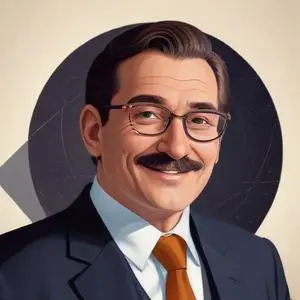
Discovered high-temperature superconductors, revolutionizing materials science and earning the Nobel Prize in Physics in 1987.
Georg Bednorz, a German physicist, catapulted to fame in 1987 when he, along with K. Alex Müller, discovered high-temperature superconductivity in ceramics, earning them the Nobel Prize in Physics. This groundbreaking finding revolutionized the field of physics, opening doors to unprecedented possibilities in energy transmission, transportation, and beyond.
Born on May 16, 1950, in Neuenkirchen, North Rhine-Westphalia, Germany, Bednorz was the youngest of four children to Anton and Elisabeth Bednorz, both elementary school and piano teachers, respectively. His parents' musical inclinations didn't immediately rub off on Georg, who instead developed a passion for tinkering with motorcycles and cars. However, he did eventually learn to play the violin and trumpet, displaying an early aptitude for the arts.
In 1968, Bednorz enrolled at the University of Münster to study chemistry. However, feeling lost in the large student body, he soon switched to the less popular subject of crystallography, a subfield of mineralogy that fascinated him. This fortuitous decision would shape his future career, as crystallography's interface with chemistry and physics provided the perfect bridge for his later research.
In 1972, Bednorz's teachers arranged for him to spend the summer at the IBM Zurich Research Laboratory as a visiting student. This experience proved pivotal, as he met his future collaborator K. Alex Müller, the head of the physics department, and immersed himself in the lab's atmosphere of creativity and freedom. The IBM lab's influence on his scientific approach cannot be overstated, as Bednorz credits it with shaping his way of conducting research.
In 1983, Bednorz, now working alongside Müller, made the groundbreaking discovery of high-temperature superconductivity in ceramics. This revolutionary finding, published in the journal Zeitschrift für Physik, sent shockwaves through the scientific community, earning them the Nobel Prize in Physics in 1987.
Bednorz's discovery has had far-reaching implications for fields like energy transmission, transportation, and medicine. His work has inspired new generations of physicists and engineers, paving the way for innovative applications in superconducting materials. Today, his legacy continues to shape the scientific landscape, driving progress toward a more efficient, sustainable future.
Beyond his scientific accomplishments, Bednorz's personal life has been marked by a strong bond with his family. He is married to his wife, Mechthild, and they have two children together. Bednorz's humility and dedication to his craft have earned him widespread respect within the scientific community.
"The most important thing is to have a sense of curiosity and to be open to new ideas."
Georg Bednorz's remarkable journey, marked by a relentless pursuit of knowledge and a willingness to challenge the status quo, serves as a beacon of inspiration for aspiring scientists and innovators worldwide.
:h2> Visual Timeline and Milestones:h2>
Born in 1901
A pioneer in quantum mechanics, he formulated the uncertainty principle, which revolutionized our understanding of the atomic world. His groundbreaking work reshaped modern physics.
Born in 1885
A pioneer in quantum mechanics, he introduced the concept of wave-particle duality, revolutionizing our understanding of atomic structure. His philosophical approach to science also explored the nature of reality and human understanding.
Born in 1908
A renowned physicist and academic who made groundbreaking contributions to our understanding of quantum mechanics, superfluidity, and particle physics, earning a Nobel Prize in Physics in 1962.
Born in 1917
A Nobel Prize-winning scientist who developed the theory of dissipative structures, which explains how complex systems can self-organize and evolve over time. His work has far-reaching implications for fields like chemistry, biology, and ecology.
Born in 1775
A pioneer in the field of electromagnetism, he formulated fundamental laws that describe the relationship between electric currents and magnetic fields. His work laid the foundation for many modern technologies, including electric motors and generators.
