


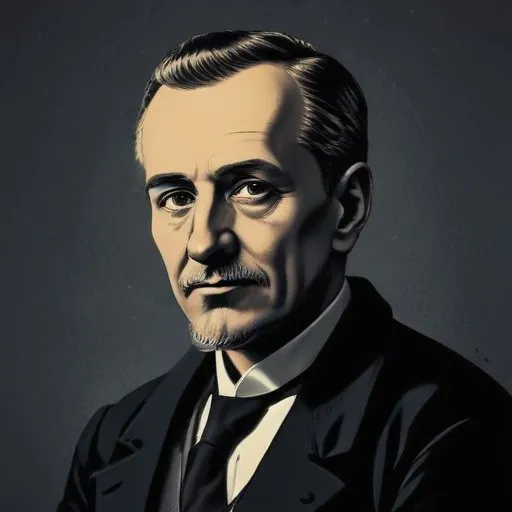
A pioneering astronomer who cataloged over 3,000 double stars and made significant contributions to the field of astrophysics. His work laid the foundation for future generations of astronomers.
Georg Hermann Struve was a renowned German astronomer from the illustrious Struve family, known for his groundbreaking contributions to the field of celestial mechanics. Specifically, he is recognized for his meticulous analysis of the movements of satellites of Saturn and Uranus, work that built upon the foundation laid by his father, Hermann Struve.
Born on December 29, 1886, in Tsarskoye Selo, Russia, Georg Struve was destined to follow in the footsteps of his father, a prominent astronomer. The family moved to Knigsberg in 1895, where Georg attended a local gymnasium before pursuing higher education. He studied at the University of Berlin and University of Heidelberg between 1905 and 1910, earning his Ph.D. in 1910.
After completing his doctorate, Struve worked at various observatories, including the Bohn Observatory, Hamburg-Bergedorf Observatory, and the Naval Observatory of Wilhelmshaven. In 1919, he joined the Berlin-Babelsberg Observatory, established by his father, where he delved deeper into celestial mechanics. Some of his notable works include:
Georg Struve married Marie von Mokk, daughter of a Prussian general, and had two sons, Wilfried and Reinhardt. His eldest son, Wilfried, followed in his footsteps, becoming a scientist who worked in astronomy and acoustics. Tragically, Reinhardt died in 1943 during World War II.
Struve's contributions to celestial mechanics paved the way for future astronomers to refine their understandings of planetary movements. His work has had a lasting impact on the field, influencing the development of modern astronomy.
Georg Hermann Struve's life was cut short when he succumbed to acute pneumonia on June 10, 1933. Despite his untimely passing, his legacy continues to inspire astronomers and scientists worldwide, ensuring that his contributions to the field of celestial mechanics remain timeless.
In conclusion, Georg Hermann Struve was a trailblazing astronomer who dedicated his life to understanding the intricacies of celestial mechanics. His groundbreaking work has left an indelible mark on the field of astronomy, cementing his place among the Struve family's long line of illustrious astronomers.
Born in 1784
Developed the Bessel functions, a set of mathematical equations crucial for astronomy, navigation, and engineering, and made the first accurate measurement of a star's distance from Earth.
Born in 1738
A pioneering astronomer and musician who discovered Uranus and two of its moons, and also composed symphonies and concertos.
Born in 1750
First female astronomer to receive a salary, discovered several comets and double stars, and assisted her brother William in his astronomical observations.
Born in 1792
Developed a system of mathematical astronomy, cataloging over 2,500 nebulae and star clusters, and made significant contributions to the field of photography. His work laid the foundation for modern astronomy and astrophysics.
