


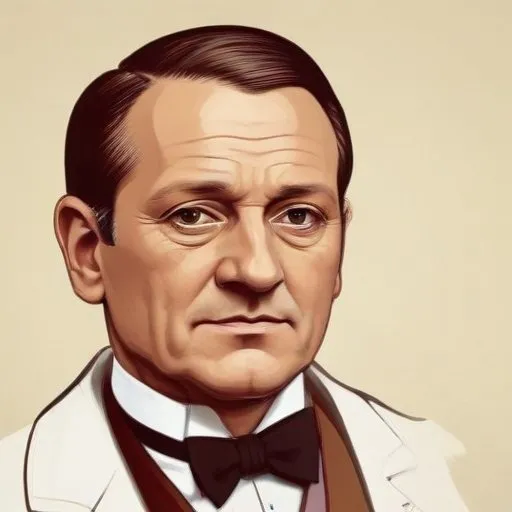
A German entomologist and academic who made significant contributions to the field of insect systematics, particularly in the study of Lepidoptera (butterflies and moths). His work laid the foundation for future generations of entomologists.
Georg Karl Maria Seidlitz was a renowned German doctor and entomologist, best known for his groundbreaking work in the field of Coleoptera, specifically in describing many new species of beetles. His most notable contribution is the publication of "Fauna Baltica. Die Kfer Coleoptera der Ostseeprovinzen Russlands" in 1875, a comprehensive treatise on the beetles of the Baltic region.
Seidlitz was born on June 19, 1840, in St. Petersburg, Russia, to a German family. Little is known about his early life, but it is evident that he developed a passion for natural sciences, particularly entomology, at a young age. He pursued his medical degree and later specialized in zoology.
Seidlitz's academic career spanned across several institutions, including the University of Dorpat, where he taught zoology from 1868 to 1877, and the University of Knigsberg, where he served as a lecturer from 1877 to 1888. During this period, he developed a keen interest in fishery and became an expert in the field.
His most significant contribution, however, lies in the field of Coleoptera. Seidlitz dedicated a significant portion of his research to studying beetles, and his work led to the discovery and description of many new species. His collection of beetles, considered one of the most extensive and valuable, is now conserved at the Zoologische Staatssammlung Mnchen in Munich.
Seidlitz was an early supporter of Charles Darwin's theory of evolution through natural selection. He was one of the first scientists in continental Europe to embrace Darwinism, and his lectures on the subject helped popularize the idea. In 1871, he published "Die Darwinsche Theorie: Elf Vorlesungen ber die Entstehung der Thiere und Planzen durch Naturzchtung," a comprehensive treatise on Darwin's theory.
Seidlitz's contributions to the field of entomology have had a lasting impact on our understanding of beetles and their diversity. His work has inspired generations of entomologists and has paved the way for further research in the field. Today, his collection remains an invaluable resource for scientists and researchers.
Seidlitz passed away on July 15, 1917, in Irschenhausen, near Munich, leaving behind a legacy that continues to inspire and influence the scientific community.
Born in 1647
A pioneering female naturalist and artist who traveled to Suriname to study and illustrate the region's exotic insects and plants, producing groundbreaking work that merged art and science.
Born in 1707
Developed the system of binomial nomenclature, which is still used today to classify and name living organisms. This system has had a profound impact on the fields of biology, ecology, and conservation.
Born in 1899
A Russian-born novelist and critic, renowned for crafting intricate, lyrical prose and exploring themes of identity, morality, and the human condition through works like "Lolita" and "Pale Fire".
Born in 1762
A French zoologist who classified and described numerous crustaceans and insects, laying the foundation for modern entomology. He's also credited with establishing the field of arachnology.
