


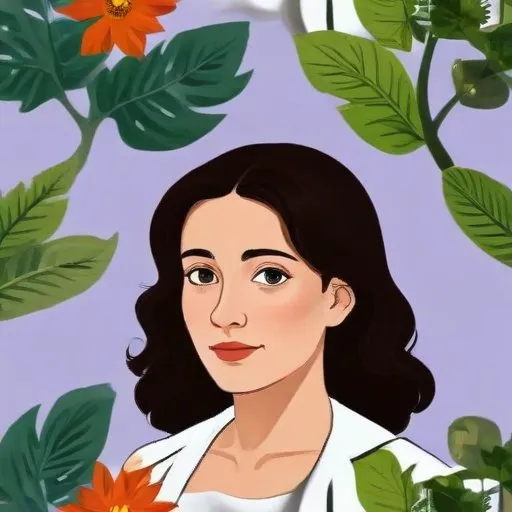
A pioneering female naturalist and artist who traveled to Suriname to study and illustrate the region's exotic insects and plants, producing groundbreaking work that merged art and science.
Maria Sibylla Merian, a 17th-century German naturalist and artist, is renowned for her groundbreaking contributions to the field of entomology. She is celebrated for her meticulous observations and detailed illustrations of insects, which dispelled the notion of spontaneous generation and established the concept of distinct life cycles in insects.
Maria Sibylla Merian was born on April 2, 1647, in Frankfurt, Germany, to the Swiss Merian family. Her artistic talents were nurtured from a young age, and she received training from her stepfather, Jacob Marrel, a student of the renowned still life painter Georg Flegel.
Merian's fascination with insects began in her adolescence. At the age of 13, she raised silkworms, and by the time she was in her early twenties, she had begun to collect and study various insect species. Her curiosity and dedication to the field led her to publish her first book of natural illustrations in 1675.
In 1679, Merian published the first volume of her two-volume series on caterpillars, followed by the second volume in 1683. Each volume contained 50 plates that she engraved and etched herself. Her work provided unprecedented documentation of the life cycles of 186 European insect species, including their metamorphosis and plant hosts.
In 1699, Merian embarked on a monumental journey to Dutch Guiana (present-day Suriname) to study and record the tropical insects native to the region. Her expedition marked a significant milestone in the history of entomology, making her one of the first European naturalists to document observations about insects directly in their tropical habitats.
In 1705, Merian published her magnum opus, Metamorphosis Insectorum Surinamensium, a comprehensive work that showcased her findings from her Dutch Guiana expedition. This publication has been credited with influencing a range of naturalist illustrators and cementing her legacy as a pioneering entomologist.
Maria Sibylla Merian's contributions to the field of entomology are immeasurable. Her meticulous observations and detailed illustrations not only dispelled the notion of spontaneous generation but also established the concept of distinct life cycles in insects. Her work has inspired generations of naturalists, including renowned figures like David Attenborough, who considers her one of the most significant contributors to the field of entomology.
Merian's groundbreaking work earned her recognition from the scientific community, and she became a respected figure in her field. Although she did not receive formal awards during her lifetime, her legacy continues to inspire and educate scientists, artists, and enthusiasts alike.
Maria Sibylla Merian's remarkable life and achievements serve as a testament to her unwavering dedication to the pursuit of scientific knowledge and artistic expression. Her pioneering work in entomology continues to inspire and educate generations, solidifying her place as one of the most important female scientists of the 17th century.
Born in 1785
A pioneering ornithologist and artist, famous for meticulously illustrating and documenting North American bird species in his iconic book "The Birds of America". His work remains a cornerstone of ornithology and wildlife art.
Born in 1769
A pioneering geographer and explorer who mapped much of South America and discovered the Caspian Sea's connection to the Black Sea, greatly advancing our understanding of the natural world.
Born in 1809
Developed the theory of evolution through natural selection, revolutionizing our understanding of life on Earth. This groundbreaking idea transformed the fields of biology, ecology, and beyond.
Born in 1823
A pioneering naturalist who discovered evolution through natural selection, independently of Charles Darwin, and contributed significantly to the field of biogeography.
Born in 1834
A German biologist, physician, and philosopher who coined the term "ecology" and made significant contributions to the field of evolutionary biology, including the recapitulation theory.
Born in 1744
A French soldier, biologist, and academic who developed a theory of inheritance of acquired characteristics, proposing that organisms adapt to their environment and pass on those traits to their offspring.
Born in 1743
Father of modern chemistry, discovered oxygen, and developed a systematic method of chemical nomenclature. He laid the foundation for modern chemistry and paved the way for future scientific discoveries.
