


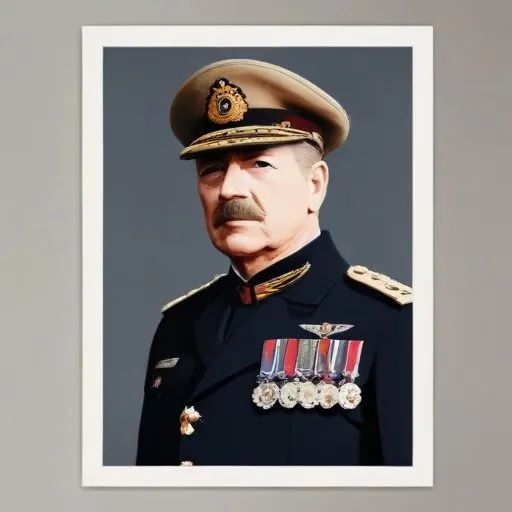
A British nobleman who served as a field marshal during the Crimean War, infamous for his role in the ill-fated Charge of the Light Brigade. He later became a politician, advocating for army reform.
George Charles Bingham, 3rd Earl of Lucan, is infamous for his role in the fateful order that led to the ill-fated Charge of the Light Brigade during the Battle of Balaclava in October 1854, one of the most disastrous military blunders in British history. Alongside Captain Nolan and Lord Raglan, Lord Lucan's decision would haunt him for the rest of his life, earning him a reputation as a ruthless and incompetent military leader.
Born on April 16, 1800, Lord Bingham was the first son of Richard Bingham, 2nd Earl of Lucan, and Elizabeth Bingham née Belasyse. He attended Westminster School but opted out of formal education to pursue a military career, commissioning as an ensign in the 6th Regiment of Foot in 1816. Over the years, he transferred between various regiments, rapidly ascending the ranks to become a lieutenant colonel of the 17th Lancers in 1826.
Lord Bingham's military prowess and family connections earned him a seat as MP for County Mayo in 1826, a position he held until 1830. During the Russo-Turkish War, he acted as an observer with the Imperial Russian Army, further solidifying his reputation as a seasoned military officer.
In 1839, Lord Bingham succeeded his father as the 3rd Earl of Lucan in the Peerage of Ireland, becoming an Irish Representative Peer in 1840. His promotion to colonel in 1841 marked the beginning of his ascension to higher ranks, culminating in his promotion to field marshal later in his career.
The Battle of Balaclava would prove to be Lord Lucan's most infamous moment, as his order led to the devastating Charge of the Light Brigade. The catastrophic event resulted in heavy casualties and widespread criticism, casting a dark shadow over Lord Lucan's military career.
Lord Lucan's reputation was further marred by his ruthless treatment of Irish tenants during the Great Famine, evicting thousands and renting his land to wealthy ranchers. However, he also played a pivotal role in allowing Jews to sit in Parliament, a progressive move for the time.
George Bingham, 3rd Earl of Lucan, remains a figures of controversy, remembered more for his failures than his achievements. His legacy serves as a reminder of the devastating consequences of poor leadership and the importance of accountability in the face of tragedy.
Born in 1769
A renowned military leader who defeated Napoleon at the Battle of Waterloo, and later served as Prime Minister of the United Kingdom, shaping the country's politics and history.
Born in 1852
A British Army officer who served as Commander-in-Chief of the British Expeditionary Force during World War I, known for his leadership during the war's early years.
Born in 1861
Led British forces during World War I, particularly in the Battle of the Somme, and was a key figure in the development of modern warfare tactics. He's also known for his controversial decisions that led to heavy casualties.
Born in 1850
A renowned British military leader and colonial administrator who played a key role in the Sudanese Mahdist War and later became a prominent figure in British politics, known for his imperialistic policies and military victories.
