


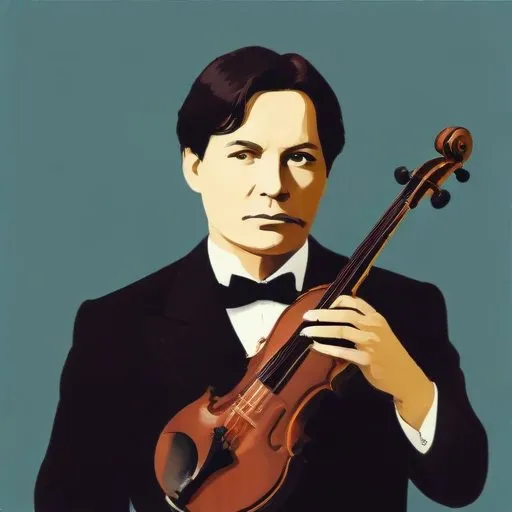
A renowned Romanian musician who excelled as a virtuosic violinist, pianist, and composer, leaving an indelible mark on the classical music world with his unique blend of folk and modernist styles.
George Enescu, a renowned Romanian composer, violinist, pianist, conductor, and teacher, is regarded as one of the greatest musicians in Romanian history. He is best known for his intricate and expressive compositions, which seamlessly blend folk melodies with classical music structures, earning him a reputation as a master of orchestral music.
Born on August 19, 1881, in the village of Liveni, Dorohoi County, Romania, Enescu was the eighth child of Costache Enescu, a landholder, and Maria Enescu (née Cosmovici), the daughter of an Orthodox priest. Displaying prodigious talent from an early age, Enescu began experimenting with composition, with his earliest surviving works being short pieces for violin and piano.
In 1888, at the age of seven, Enescu became the youngest student ever admitted to the Vienna Conservatory, where he studied with prominent musicians such as Joseph Hellmesberger Jr., Robert Fuchs, and Sigismund Bachrich. This precocious talent earned him recognition, and by the age of ten, he was already performing private concerts at the Court of Vienna, in the presence of Emperor Franz Joseph.
Enescu's compositions showcase a unique blend of Romanian folk melodies, classical music structures, and innovative techniques. His works span a wide range of genres, from symphonies and orchestral suites to chamber music, piano sonatas, and vocal pieces. Notable compositions include his Overture on Romanian Folk Themes, Rhapsody for Orchestra, and Sonata No. 3 for Piano and Violin.
Enescu's style is characterized by rich harmonies, complex rhythms, and a deep sense of lyricism. His music often features intricate instrumental textures, which showcase his exceptional technical skill as a violinist and pianist. As a conductor, Enescu was known for his energetic and expressive performances, which earned him acclaim both in Romania and internationally.
Enescu's contributions to music have had a profound impact on modern society. His unique blend of folk and classical music has inspired generations of composers, including notable figures such as Béla Bartók and Sergiu Celibidache. His music has also been featured in numerous films, ballets, and theatrical productions, introducing his work to a broader audience.
In his native Romania, Enescu is revered as a cultural icon, with many institutions and festivals bearing his name. The George Enescu International Festival and Competition, held annually in Bucharest, is one of the most prestigious music events in Eastern Europe, attracting renowned musicians and composers from around the world.
Enescu's personal life was marked by a strong sense of patriotism and a deep commitment to his Romanian heritage. He was married to Maria Cantacuzino, a member of a prominent Romanian aristocratic family, and had one son, Mihail.
Throughout his life, Enescu received numerous accolades and honors for his contributions to music, including the Romanian Crown's Order of Cultural Merit and the French Legion of Honor. He passed away on May 4, 1955, leaving behind a legacy as one of the most important Romanian musicians of the 20th century.
These words, spoken by Enescu himself, reflect his profound understanding of the power and essence of music, and continue to inspire generations of musicians and music lovers alike.
Born in 1881
A Hungarian musical genius who merged folk melodies with modernist techniques, creating a unique sound that transformed classical music.
Born in 1882
A Hungarian composer, conductor, and musicologist who developed a unique style blending folk and classical music, and is renowned for his contributions to music education and ethnomusicology.
Born in 1875
A virtuosic violinist and composer, renowned for his mesmerizing performances and exquisite compositions that blended classical and romantic styles. His music still enchants audiences today.
Born in 1901
A virtuosic violinist renowned for his technical perfection, tone, and phrasing, revolutionizing the art of violin playing through his recordings and teaching.
Born in 1858
A renowned violinist, composer, and conductor, known for his virtuosic performances and innovative compositions that expanded the violin repertoire. He was a key figure in the development of modern violin technique.
Born in 1876
A renowned Catalan musician, he was a master cellist and conductor, celebrated for his expressive performances and interpretations of Bach's cello suites. He's also credited with popularizing classical music globally.
Born in 1897
A renowned conductor and composer, known for his precise and expressive performances, leading the Cleveland Orchestra to international acclaim. His interpretations of classical music remain highly influential.
Born in 1874
A renowned bassist, composer, and conductor who led the Boston Symphony Orchestra for 25 years, introducing many American premieres of works by prominent composers. He was a champion of modern classical music.
