


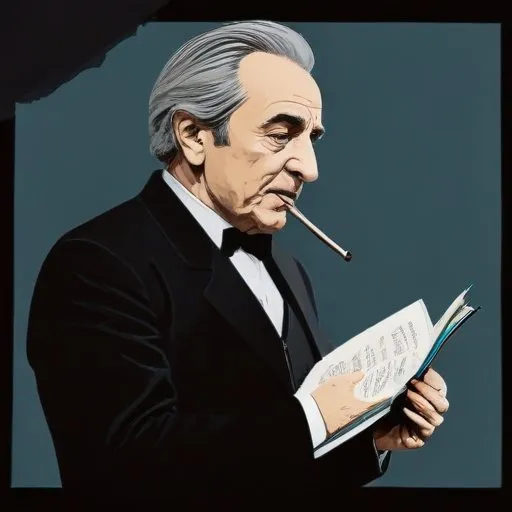
A renowned Romanian conductor and composer, celebrated for his intense and expressive performances, particularly with the Munich Philharmonic Orchestra. He's also known for his unconventional rehearsal techniques and emphasis on musical expression over technical perfection.
Sergiu Celibidache, the renowned Romanian conductor, composer, and musical theorist, is celebrated for his unwavering dedication to the pursuit of musical perfection and his refusal to compromise on artistic integrity. Throughout his illustrious career, Celibidache mesmerized audiences with his unique blend of technical mastery and profound musical insight, earning him the reputation as one of the greatest conductors of the 20th century.
Born on June 28, 1912, in Roman, Romania, Celibidache was destined for a life of music. His early years were marked by a prodigious talent, with the young Celibidache improvising at the piano by the tender age of four. His father, Demostene Celebidachi, a cavalry officer, recognized his son's gift and encouraged his pursuit of music.
Celibidache's musical education took him to Bucharest and eventually to Paris, where he honed his skills in mathematics, philosophy, and music. In 1936, he enrolled in the Hochschule für Musik in Berlin, where he began to forge his unique musical identity. It was during this period that German authorities mistakenly altered his surname from Celebidachi to Celibidache, a change that would remain permanent.
With his talent and training, Celibidache embarked on a storied career that spanned over five decades. He held principal conductor positions with some of Europe's most esteemed orchestras, including the Munich Philharmonic, Berlin Philharmonic, and Sicilian Symphony Orchestra. His collaborations with these ensembles yielded performances that were nothing short of transcendent, leaving audiences and critics alike in awe.
In a bold move that has become synonymous with Celibidache's persona, he refused to release his performances on commercial recordings during his lifetime. This decision was rooted in his conviction that the true essence of music could only be experienced within the concert hall, where the energy and emotion of the performer and audience converged. While this stance may have limited his global reach, it has not diminished the reverence in which his artistry is held.
As his career progressed, Celibidache turned his attention to nurturing the next generation of musicians. He taught at Mainz University in Germany and the Curtis Institute of Music in Philadelphia, Pennsylvania, imparting his wisdom and expertise to countless students. This chapter of his life was marked by a sense of humility and generosity, as he shared his knowledge and passion with those eager to learn.
Sergiu Celibidache's impact on the world of classical music is profound and far-reaching. His unique blend of technical mastery, musical insight, and philosophical convictions has left an indelible mark on the art form. Today, his recordings, though released posthumously, continue to inspire and enlighten audiences, ensuring that his legacy will endure for generations to come.
As we reflect on the life and artistry of Sergiu Celibidache, we are reminded that true greatness is not measured by fame or fortune, but by the indomitable spirit and unwavering dedication to one's craft. His is a legacy that will continue to inspire and uplift, a testament to the transformative power of music to touch the human soul.
Born in 1908
A renowned maestro who led the Berlin Philharmonic for over three decades, elevating its reputation through precise and dramatic performances. He's also famous for his numerous recordings and charismatic stage presence.
Born in 1912
A renowned maestro who led the Chicago Symphony Orchestra to international acclaim, known for his intense performances and numerous recordings of operas and symphonies.
Born in 1918
A renowned musician who blended jazz, classical, and Broadway styles, creating iconic works like West Side Story, and inspiring generations with his charismatic performances and innovative compositions.
Born in 1925
A renowned French musician who revolutionized classical music with his avant-garde compositions and innovative conducting style, pushing boundaries and redefining the genre.
Born in 1899
A renowned violinist and conductor, leading the Philadelphia Orchestra for over 40 years, known for his technical precision and interpretations of Romantic-era composers.
Born in 1903
A renowned Russian conductor, celebrated for his interpretations of Russian classical music, particularly the works of Shostakovich and Tchaikovsky.
Born in 1891
A renowned violinist and conductor, leading the Boston Symphony Orchestra to new heights, and premiering works by famous composers like Debussy and Ravel.
Born in 1888
A renowned maestro who led the Chicago Symphony Orchestra to new heights, earning a reputation for his precise and powerful interpretations of classical music.
