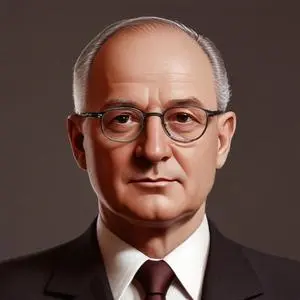
George F. Kennan: The Visionary Diplomat Who Shaped the Cold War
The Architect of Containment
George F. Kennan is renowned for his pivotal role in shaping the United States' foreign policy during the Cold War era. As a diplomat, historian, and advocate of containment, Kennan's writings and ideas significantly influenced the Truman Doctrine, the Marshall Plan, and the country's overall approach to dealing with the Soviet Union.
A Life of Diplomacy and Scholarship
Born on February 16, 1904, in Milwaukee, Wisconsin, Kennan was raised in a family of modest means. He developed a passion for languages and international relations, which led him to study at Princeton University and later at the University of Berlin. Kennan joined the U.S. Foreign Service in 1926 and served in various capacities, including as a diplomat in Moscow and Berlin.
The Long Telegram and the Sources of Soviet Conduct
Kennan's most significant contribution to the Cold War era was his 8,000-word "Long Telegram" sent from Moscow in 1946, which outlined his observations on the Soviet Union's expansionist policies. This groundbreaking document argued that the Soviet regime was inherently expansionist and recommended a policy of containment to counter its influence. Kennan's subsequent article, "The Sources of Soviet Conduct," published in 1947, reiterated these sentiments and further solidified his position as a leading authority on Soviet affairs.
Influence on U.S. Foreign Policy
Kennan's ideas and writings had a profound impact on U.S. foreign policy, particularly during the Truman administration. His concepts of containment and the importance of addressing the Soviet Union's expansionist tendencies shaped the Truman Doctrine, the Marshall Plan, and other key initiatives. Kennan's advocacy for a nuanced approach to Soviet relations also led to the establishment of the Policy Planning Staff, a think tank within the State Department.
A Critic of Militarization
However, as the Cold War intensified, Kennan became increasingly disillusioned with the militarization of U.S. foreign policy. He began to criticize the Truman administration's aggressive stance, advocating instead for a more nuanced and diplomatic approach. Kennan's influence waned, and he eventually left the State Department in 1950 to pursue a career in academia.
A Life of Reflection and Critique
As a professor at the Institute for Advanced Study, Kennan continued to analyze international affairs and critique U.S. foreign policy. He wrote extensively on the dangers of militarization, the importance of diplomacy, and the need for a more nuanced understanding of Soviet intentions. Kennan's later years were marked by a sense of disillusionment with the course of U.S. foreign policy, which he believed had strayed from his original vision of containment.
Personal Life and Legacy
Kennan's personal life was marked by a deep love for nature, literature, and the arts. He was an avid reader, linguist, and traveler, and his experiences abroad greatly influenced his worldview. Married to Annelise Sørensen, Kennan had four children and lived a long and fulfilling life, passing away on March 17, 2005, at the age of 101.
Key Works and Awards
- "The Long Telegram" (1946)
- "The Sources of Soviet Conduct" (1947)
- "American Diplomacy, 1900-1950" (1951)
- "Realities of American Foreign Policy" (1954)
- Pulitzer Prize for History (1957)
- Albert Lasker Public Service Award (1953)
Remembering George F. Kennan
George F. Kennan's legacy is complex and multifaceted, marked by both profound contributions to the realm of international relations and critique of the very policies he helped shape. As a diplomat, historian, and advocate, Kennan's impact on the Cold War era is undeniable, and his ideas continue to influence U.S. foreign policy to this day.
FAQ
What was George F. Kennans role in shaping US foreign policy?
George F. Kennan was a key figure in shaping US foreign policy during the Cold War, serving as the United States Ambassador to the Soviet Union from 1952 to 1953. He was a strong advocate for containment, advising the US government to adopt a policy of economic and military resistance to Soviet expansionism.
What was George F. Kennans contribution to the development of the Marshall Plan?
George F. Kennan played a significant role in the development of the Marshall Plan, a US-led initiative to provide economic aid to war-torn Europe. He was part of the State Departments Policy Planning Staff, which helped shape the plans strategy and implementation.
What is George F. Kennans most famous writing?
George F. Kennans most famous writing is the Long Telegram, a 1946 dispatch to the State Department that outlined the Soviet Unions post-war intentions and advocated for a policy of containment.
What awards did George F. Kennan receive for his diplomatic service?
George F. Kennan received the Presidential Medal of Freedom in 1964, the highest civilian honor in the United States, for his exceptional service as a diplomat and historian.
What is George F. Kennans connection to the X Article?
George F. Kennan wrote the X Article, a 1947 article published in Foreign Affairs magazine, which outlined the principles of containment and became a seminal work in the development of US Cold War policy.