


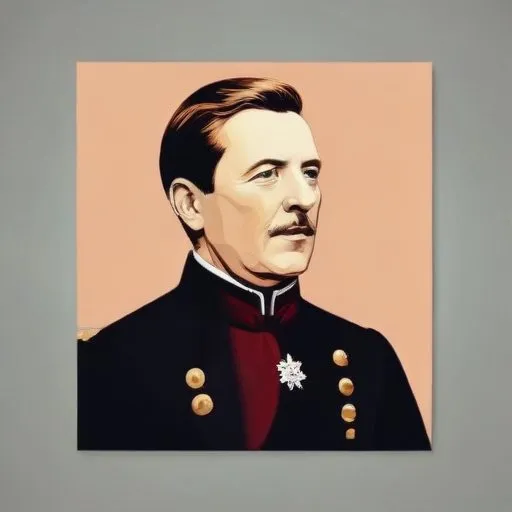
A prominent Royalist commander during the English Civil War, he led cavalry forces and fought in several key battles, earning a reputation for bravery and military skill.
George Goring, Lord Goring, was a prominent English Royalist soldier known for his distinguished military career and his involvement in significant events that shaped the course of English history. He is particularly recognized for his bravery during the English Civil Wars and his role in the Siege of Portsmouth in 1642.
Born on July 14, 1608, George Goring was the eldest son of George Goring, 1st Earl of Norwich. He began his military career in the Dutch Army, where he attained the rank of colonel with the help of his father-in-law, Richard Boyle, 1st Earl of Cork. Goring's experiences during the Siege of Breda in 1637 left him permanently lamed, but this did not deter him from pursuing a career in the military.
In 1639, Goring returned to England and was appointed governor of Portsmouth. He played a significant role in the Bishops' Wars and gained considerable recognition for his military prowess. His reputation preceded him when he became embroiled in the Army Plot of 1641, a conspiracy to overthrow the government.
In 1641, Goring proposed to march the army on London and overthrow the Parliament during Strafford's trial. However, when his fellow officers rejected his plan, he betrayed their plot to Mountjoy Blount, 1st Earl of Newport, who then informed John Pym. This betrayal earned Goring the commendation of the Commons, who praised him for his services to the Commonwealth.
Despite his earlier betrayal, Goring declared his loyalty to King Charles I in August 1642. He surrendered Portsmouth to the Parliament in September 1642, after the Siege of Portsmouth, and later traveled to the Netherlands to recruit for the Royalist army. He returned to England in December 1642 and was appointed to a cavalry command by the Earl of Newcastle.
Goring achieved a significant victory over Fairfax at Seacroft Moor near Leeds in March 1643. This triumph solidified his position as a respected military leader and further earned him the trust of King Charles I.
George Goring, Lord Goring, left behind a legacy of military prowess and controversy. His involvement in the Army Plot and his eventual betrayal of his fellow officers have been the subject of much debate among historians. Despite this, his bravery and achievements during the English Civil Wars have ensured his place in the annals of English history.
George Goring, Lord Goring, remains a fascinating figure in English history, known for his complex personality, military prowess, and the controversy that surrounds his life and actions.
Born in 1599
Leader of the Parliamentarian forces during the English Civil War, who later ruled England, Scotland, and Ireland as a republican dictator, known for his military victories and radical reforms.
Born in 1573
A 17th-century Archbishop of Canterbury who played a significant role in shaping the Church of England, known for his efforts to impose uniformity and suppress Puritanism.
