


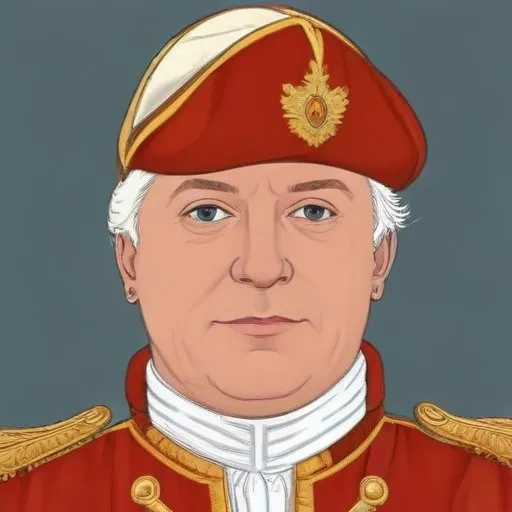
A German prince who ruled Anhalt-Dessau from 1751 to 1817, known for his military reforms and cultural achievements. He was a prominent figure in the Enlightenment era, supporting arts and education.
George III, Prince of Anhalt-Dessau, was a prominent figure in the 16th century, known for his role as a Protestant Reformer and the ruler of the principality of Anhalt-Dessau. As a member of the House of Ascania, he played a significant role in shaping the religious and political landscape of his time.
Born on August 15, 1507, George III was the third but second surviving son of Ernest I, Prince of Anhalt-Dessau, and his wife Margaret of Münsterberg. He was brought up along with his brothers John V and Joachim I by their devout mother, who instilled in them strong Christian values. After the death of his father in 1516, George inherited Anhalt-Dessau as a co-ruler with his brothers, initially under the regency of their mother.
George's education and upbringing played a significant role in shaping his future as a Protestant Reformer. He attended the University of Leipzig, where he was deeply influenced by the theologian Georg Helt of Forchheim. In 1518, he was elevated to the rank of Canon in the See of Merseburg, and in 1524, he was consecrated as a priest by Adolph, the Bishop of Merseburg.
George III's involvement in the Protestant Reformation was a turning point in his life. In 1530, he allied himself with the Lutherans, along with his brothers, and began to implement reforms in his principality. He introduced the Evangelical celebration of the Mass in Dessau in 1534, making him one of the first Protestant rulers in the region.
As a ruler, George III was known for his pragmatic approach to religious reform. He sought to maintain peace and stability in his principality, often finding himself at odds with more radical Reformers. His measured approach earned him the respect of Martin Luther himself, who acquiesced to George's gradual implementation of reforms.
George III, Prince of Anhalt-Dessau, left a lasting legacy as a Protestant Reformer and a shrewd politician. His measured approach to religious reform helped maintain stability in his principality, while his commitment to the Evangelical cause earned him a place among the prominent figures of the Reformation era.
Through his rulership, George III contributed to the growth of Protestantism in Germany, paving the way for future generations of reformers and theologians. His legacy continues to inspire and educate people to this day, serving as a testament to the power of faith and conviction in shaping the course of history.
Born in 1837
Ruler of Hesse from 1877 to 1892, known for his marriage to Princess Alice, Queen Victoria's daughter, and his role in the unification of Germany.
Born in 1683
King of Great Britain and Ireland from 1727 to 1760, known for his military victories, particularly the Battle of Dettingen, and his role in the War of the Austrian Succession.
Born in 1670
A powerful Polish king who transformed his country into a major European power through military conquests and cultural achievements, earning him the nickname "the Strong".
Born in 1712
Prussian king who ruled with Enlightenment values, promoting arts, education, and religious tolerance, while also being a skilled military strategist and expanding his kingdom through wars.
