


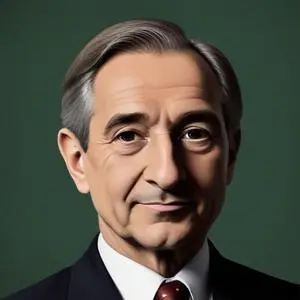
A renowned mathematician and academic who developed influential problem-solving strategies and wrote seminal books on mathematics, making complex concepts accessible to a broad audience.
George Pólya, a Hungarian-American mathematician, is renowned for his groundbreaking contributions to combinatorics, number theory, numerical analysis, and probability theory. His work in heuristics and mathematics education has left an indelible mark on the mathematical community, earning him a place among the most influential mathematicians of the 20th century.
Born on December 13, 1887, in Budapest, Austria-Hungary, to Anna Deutsch and Jakab Pólya, George was raised in a family that valued education and intellectual pursuits. His parents, Hungarian Jews who had converted to Christianity, instilled in him a strong work ethic and encouraged his curiosity. Pólya received his PhD in 1912 from Etvs Loránd University under the guidance of Lipt Fejér, one of the most prominent Hungarian mathematicians of the time.
Pólya's academic career spanned over six decades, during which he held professorships at ETH Zurich (1914-1940) and Stanford University (1940-1953). His contributions to mathematics are vast and varied, with significant impacts on:
Pólya's most enduring legacy lies in his work on heuristics, the art of solving mathematical problems. His book, "How to Solve It," has become a classic in the field, offering practical advice and strategies for approaching complex problems. His emphasis on the importance of problem-solving and critical thinking has influenced generations of mathematicians and educators.
Pólya's work has had a significant impact on modern society, with applications in:
Pólya's life was marked by significant milestones, including:
George Pólya's legacy extends beyond his mathematical contributions. He was part of an informal group known as "The Martians," which included prominent mathematicians such as John von Neumann. Pólya's work has been recognized through numerous awards and honors, including the Leroy P. Steele Prize for Mathematical Exposition in 1976.
In conclusion, George Pólya's impact on mathematics, education, and modern society is immeasurable. His work continues to inspire and influence mathematicians, educators, and problem-solvers around the world, cementing his place as one of the most important mathematicians of the 20th century.
Born in 1903
Pioneering mathematician and physicist who developed the concept of the modern computer architecture and made significant contributions to quantum mechanics and game theory. His work laid the foundation for modern computing and artificial intelligence.
Born in 1902
A Hungarian physicist and mathematician who made groundbreaking contributions to quantum mechanics and nuclear physics, and was awarded the Nobel Prize in Physics in 1963.
Born in 1913
A prolific mathematician who traveled the world, collaborating with others to solve problems and create new theories, producing over 1,500 papers and inspiring a new generation of mathematicians. Known for his eccentric personality and love of coffee.
Born in 1917
A renowned mathematician who made significant contributions to number theory, particularly in the development of the Selberg trace formula, and was awarded the Fields Medal and the Abel Prize.
Born in 1906
A French mathematician and academic who made significant contributions to number theory, algebraic geometry, and the development of modern mathematics, leaving a lasting impact on the field.
Born in 1882
A pioneering mathematician and physicist who revolutionized abstract algebra and made groundbreaking contributions to modern physics, particularly in the development of Einstein's theory of general relativity.
Born in 1862
A renowned mathematician and academic who developed infinite-dimensional vector spaces and laid the foundation for quantum mechanics and relativity. He's also famous for his 23 unsolved math problems that shaped 20th-century mathematics.
Born in 1864
Developed groundbreaking geometric methods that transformed our understanding of space and time, and his work laid the foundation for Einstein's theory of relativity.
