


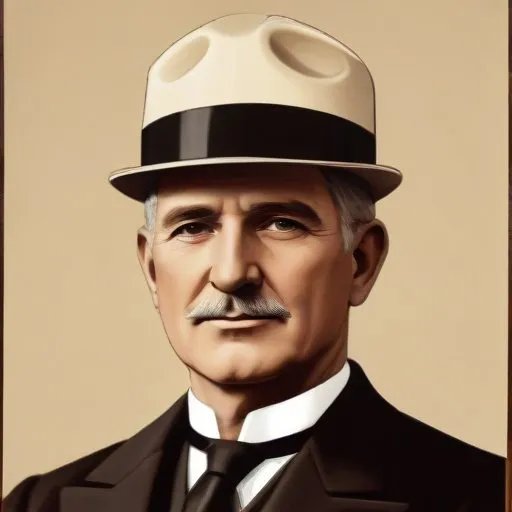
Founded the Pullman Company, revolutionizing rail travel with luxurious sleeper cars, and creating a company town for employees. Known for his innovative approach to transportation and labor practices.
George Pullman, a pioneering engineer and industrialist, is best known for designing and manufacturing the Pullman sleeping car, a revolutionary innovation that transformed the railroad industry. His eponymous company, the Pullman Company, not only produced luxurious railcars but also founded a company town in Chicago, which would later become a contentious symbol of labor unrest.
Born on March 3, 1831, in Brocton, New York, Pullman grew up in a family of modest means. His father, James Lewis Pullman, was a carpenter and inventor who patented a machine for moving buildings in 1841. This early exposure to innovation and mechanical ingenuity sparked Pullman's fascination with engineering and problem-solving. After his father's death in 1853, Pullman took over the family business and honed his skills as a carpenter and mechanic.
In the late 1850s, Pullman designed and built his first sleeping car, which debuted in 1859. This pioneering invention featured luxurious amenities, including plush furnishings, dining facilities, and personalized service. The Pullman sleeping car quickly became the epitome of comfort and elegance in rail travel, catering to the needs of the wealthy and discerning passengers. By the 1880s, Pullman's company had become the dominant manufacturer of sleeping cars, with its iconic railcars synonymous with luxury and sophistication.
In 1881, Pullman founded a company town in Chicago, which he named Pullman. This ambitious project aimed to provide affordable housing, amenities, and recreational facilities for the workers who manufactured his sleeping cars. However, the town's high rent prices, low wages, and paternalistic management style soon sparked labor unrest and resentment among the workers. The Pullman Strike of 1894, which demanded better working conditions and fair wages, ended in tragedy with the deployment of federal troops, resulting in the deaths of 30 strikers.
The Pullman Strike and its violent suppression led to a national outcry and a government investigation, ultimately resulting in the Illinois Supreme Court ordering the Pullman Company to divest itself of the town in 1898. Pullman's reputation suffered as a result, and he became synonymous with the exploitation of workers. However, his pioneering innovations in rail travel and his visionary approach to urban planning remain an important part of his legacy.
Pullman married Harriet Sanger in 1860, and the couple had two children. He was known for his philanthropic efforts, particularly in education and healthcare. Pullman's contributions to the University of Chicago and the Pullman Free School of Manual Training, which provided vocational training to young men, reflect his commitment to social responsibility.
At the height of his success, Pullman's net worth was estimated to be around $12 million (approximately $375 million in today's currency). His innovative designs and manufacture of sleeping cars generated immense profits, making him one of the wealthiest entrepreneurs of his time.
George Pullman's life and career reflect the complexities of the Gilded Age, marked by rapid industrialization, labor unrest, and the struggle for social justice. His pioneering achievements in rail travel and urban planning continue to inspire innovation and entrepreneurship, while his controversial management practices serve as a cautionary tale about the importance of fair labor practices and corporate social responsibility.
Born in 1794
Built railroad empires, revolutionizing transportation and commerce, and donated extensively to education and the arts.
Born in 1836
A ruthless and cunning financier who dominated the railroad industry in the late 19th century, known for his clever business tactics and questionable ethics.
Born in 1811
Founded the company that revolutionized urban architecture by inventing the first safe elevator, enabling the construction of skyscrapers. He's credited with transforming cityscapes and modernizing urban living.
Born in 1809
Co-founder of International Harvester, a pioneering manufacturer of agricultural machinery, revolutionizing farming with the mechanical reaper, increasing food production and transforming the industry.
Born in 1804
Founded a company that revolutionized agriculture with innovative farming equipment, making farming more efficient and productive. Today, the company is a global leader in agricultural machinery and technology.
Born in 1838
Built the Great Northern Railway, connecting the Midwest to the Pacific Northwest, revolutionizing transportation and commerce in the region.
