


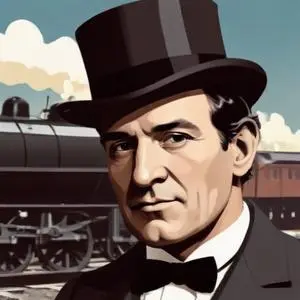
Designed the Liverpool and Manchester Railway, a pioneering feat that revolutionized transportation and paved the way for modern rail networks.
George Stephenson, a renowned English civil engineer and mechanical engineer, is celebrated as the "Father of Railways" for his groundbreaking contributions to the development of rail transportation during the Industrial Revolution. His innovative designs and perseverance paved the way for the creation of modern railways, revolutionizing the way people and goods moved around the world.
Born on June 9, 1781, in Wylam, Northumberland, England, Stephenson grew up in a humble household where his parents, Robert and Mabel, struggled to make ends meet. Despite the family's financial constraints, Stephenson's thirst for knowledge and self-improvement drove him to educate himself, eventually learning to read and write at the age of 18.
Stephenson's early career as an engineman and brakesman at various collieries in Northumberland laid the foundation for his future success. In 1814, he designed his first steam-powered locomotive, the "Blücher," which could haul 30 tons of coal up a slight incline. This achievement sparked a wave of interest in steam-powered locomotives, and soon, Stephenson was in high demand as a railway engineer.
Stephenson's pioneering work in rail transportation had a profound impact on modern society. His innovations enabled the rapid expansion of industry, commerce, and tourism, transforming the way people lived, worked, and traveled. Today, his legacy continues to shape the world, with railways remaining a vital component of global transportation networks.
"The greatest glory in living lies not in never falling, but in rising every time we fall." - George Stephenson
Stephenson's accomplishments must be viewed within the context of the Industrial Revolution, a period of rapid technological innovation and industrialization. His contributions to the development of railways can be compared to other pioneering engineers of the time, such as Isambard Kingdom Brunel and Richard Trevithick, who also played crucial roles in shaping the modern transportation landscape.
George Stephenson's remarkable life and achievements serve as a testament to the power of innovation, perseverance, and hard work. As the "Father of Railways," he left an indelible mark on the world, shaping the course of modern transportation and cementing his place in history as one of the most influential engineers of all time.
Born in 1806
A visionary engineer who revolutionized transportation with innovative designs, including the iconic Clifton Suspension Bridge, which transformed urban landscapes.
Born in 1771
Built steam-powered locomotives, revolutionizing land transportation, and pioneered the use of steam engines in mines.
Born in 1791
Pioneering scientist who discovered electromagnetic induction, formulated the laws of electrolysis, and invented the first electrical generator, revolutionizing our understanding of electricity and its applications.
Born in 1736
Improved steam engine efficiency, revolutionizing industry and transportation. Known for his innovative designs and patents that transformed the Industrial Revolution.
Born in 1773
Designed and built the first successful glider, pioneering modern aeronautical engineering, and is often credited with inventing the first powered, heavier-than-air aircraft.
Born in 1791
A pioneer in computer science, credited with inventing the first mechanical computer, the Difference Engine, and conceptualizing the Analytical Engine, a precursor to modern computers.
Born in 1815
Pioneering mathematician and computer scientist who wrote the first algorithm intended to be processed by a machine, and is often considered the first computer programmer. Her work on Charles Babbage's Analytical Engine envisioned its potential to go beyond mere calculation and perform any task that could be expressed in a series of steps.
Born in 1813
Developed a cost-effective process for mass-producing steel, revolutionizing industry and transportation. This innovation transformed the construction of buildings, bridges, and railways.
