


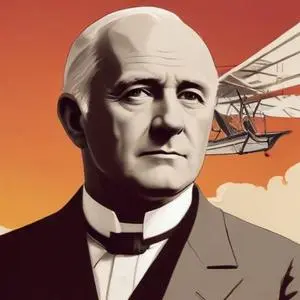
Designed and built the first successful glider, pioneering modern aeronautical engineering, and is often credited with inventing the first powered, heavier-than-air aircraft.
Sir George Cayley, 6th Baronet, is renowned for being the first true scientific aerial investigator and the father of aviation, pioneering the concept of the modern aeroplane and identifying the fundamental forces of flight.
Born on December 27, 1773, in Bromptonby-Sawdon, near Scarborough in Yorkshire, England, Cayley inherited Brompton Hall and Wydale Hall, along with other estates, upon the death of his father, the 5th baronet.
Cayley's groundbreaking work in aeronautics began in 1799, when he set forth the concept of the modern aeroplane as a fixed-wing flying machine with separate systems for lift, propulsion, and control. This revolutionary idea laid the foundation for modern aeroplane design.
Cayley identified the four fundamental forces that act on a heavier-than-air flying vehicle: weight, lift, drag, and thrust. This discovery remains a cornerstone of aeronautical engineering, influencing the development of modern aeroplanes.
Cayley's innovative spirit led to several pioneering achievements, including:
Cayley's work had a profound impact on the development of aviation, with the Wright brothers acknowledging his significance in the field. His contributions paved the way for sustained flight, which became a reality with the invention of lightweight engines.
Beyond his groundbreaking work in aeronautics, Cayley was an active philanthropist and public servant. He represented the Whig party as Member of Parliament for Scarborough from 1832 to 1835 and helped found the UK's first Polytechnic Institute, the Royal Polytechnic Institution (now University of Westminster), serving as its chairman for many years.
Cayley was a distant cousin of the mathematician Arthur Cayley and was elected as a Vice-President of the Yorkshire Philosophical Society in 1824. He was also a founding member of the British Association for the Advancement of Science.
Sir George Cayley's visionary work in aeronautics, philanthropy, and public service has left an indelible mark on history. As the father of aviation, his contributions continue to inspire innovation and progress in the field, cementing his place as one of the most important figures in the history of aeronautics.
Born in 1806
A visionary engineer who revolutionized transportation with innovative designs, including the iconic Clifton Suspension Bridge, which transformed urban landscapes.
Born in 1791
Pioneering scientist who discovered electromagnetic induction, formulated the laws of electrolysis, and invented the first electrical generator, revolutionizing our understanding of electricity and its applications.
Born in 1791
A pioneer in computer science, credited with inventing the first mechanical computer, the Difference Engine, and conceptualizing the Analytical Engine, a precursor to modern computers.
Born in 1815
Pioneering mathematician and computer scientist who wrote the first algorithm intended to be processed by a machine, and is often considered the first computer programmer. Her work on Charles Babbage's Analytical Engine envisioned its potential to go beyond mere calculation and perform any task that could be expressed in a series of steps.
Born in 1781
Designed the Liverpool and Manchester Railway, a pioneering feat that revolutionized transportation and paved the way for modern rail networks.
Born in 1771
Built steam-powered locomotives, revolutionizing land transportation, and pioneered the use of steam engines in mines.
Born in 1736
Improved steam engine efficiency, revolutionizing industry and transportation. Known for his innovative designs and patents that transformed the Industrial Revolution.
Born in 1856
A pioneering engineer who harnessed the power of alternating current (AC) to transform the world's electrical systems, and is credited with developing groundbreaking technologies like radio communication and X-ray imaging.
