


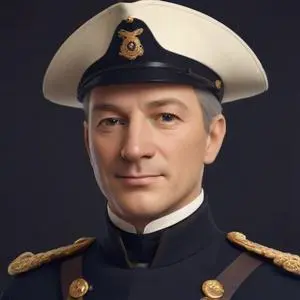
Led a British expedition to chart the Pacific Northwest coast of North America, discovering and naming many geographic features, including Vancouver Island. He's also known for his interactions with indigenous peoples and his role in British colonialism.
George Vancouver, a British Royal Navy officer, is renowned for his groundbreaking expedition from 1791 to 1795, which meticulously charted and explored the northwestern Pacific Coast regions of North America, including present-day British Columbia, Alaska, Washington, Oregon, and California. This remarkable journey also took him to the Hawaiian Islands and the southwest coast of Australia, leaving an indelible mark on the world of navigation and geographical discovery.
Born on June 22, 1757, in the seaport town of King's Lynn, Norfolk, England, Vancouver was the sixth and youngest child of John Jasper Vancouver, a Dutch-born deputy collector of customs, and Bridget Berners.
At the tender age of 13, Vancouver embarked on his naval career, entering the Royal Navy as a young gentleman and future candidate for midshipman. He served on HMS Resolution during James Cook's second voyage from 1772 to 1775, which searched for the fabled Terra Australis. This experience not only shaped his navigational skills but also instilled in him a sense of adventure and探索.
Vancouver's most notable achievement was his 1791-1795 expedition, which he commanded. During this period, he skillfully navigated his ships, HMS Discovery and HMS Chatham, through treacherous waters, mapping the coastline with precision and gathering valuable insights into the region's geography, geology, and indigenous populations.
In the wake of his expedition, numerous geographical features were named in his honor, including Vancouver Island, the city of Vancouver in British Columbia, Vancouver River, and Mount Vancouver on the Canadian-US border.
Vancouver's contributions to the field of navigation and geography are immeasurable. His detailed charts and journals provided valuable resources for future explorers, traders, and settlers, facilitating the growth of commerce and settlement in the Pacific Northwest.
Despite his many achievements, Vancouver's personal life was marked by controversy and hardship. He faced criticism from his contemporaries, who questioned the accuracy of his charts and the success of his expedition.
Vancouver never married, and his personal relationships were often conflicted. However, his dedication to his work and his country remained unwavering, earning him a reputation as a fearless and resourceful navigator.
George Vancouver's remarkable life and achievements serve as a testament to his unwavering dedication to exploration and discovery. His legacy continues to inspire generations of navigators, cartographers, and historians, reminding us of the importance of perseverance, curiosity, and the pursuit of knowledge.
"The object of my journey is to explore the coast of North America, and to find a passage from the Pacific to the Atlantic Ocean." – George Vancouver
41 Years Old
A Welsh rugby union player who captained Wales and the British and Irish Lions, known for his exceptional skill and leadership on the pitch.
Born in 1822
The second Prime Minister of Canada, serving from 1873 to 1878, known for establishing the Supreme Court of Canada and promoting unity among the provinces.
Born in 1776
Fur trader and explorer who mapped much of British Columbia and opened up the region to European settlement, leading to significant cultural and economic changes.
Born in 1770
Mapped vast regions of North America, including the Columbia River, and created highly accurate maps that helped shape the continent's geography.
Born in 1786
A British naval officer and politician who governed Van Diemen's Land (now Tasmania) and led Arctic expeditions, known for his ill-fated quest to find the Northwest Passage.
