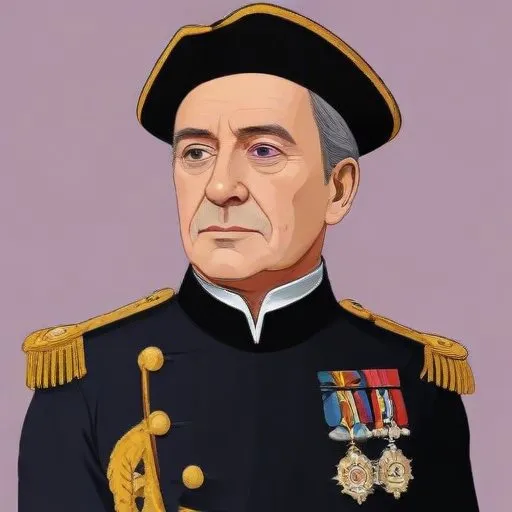
Sir John Franklin: The Ill-Fated Arctic Explorer
A Life of Adventure and Tragedy
Sir John Franklin, a British Royal Navy officer and explorer, is infamous for his ill-fated expedition to the Canadian Arctic, which ultimately claimed his life. He is known for leading three expeditions into the Arctic, with his final attempt to traverse the Northwest Passage resulting in the loss of his ships, crew, and ultimately, his own life.
Early Life and Career
Born on April 16, 1786, in Spilsby, Lincolnshire, Franklin was the ninth of twelve children to Hannah Weekes and Willingham Franklin. His family's modest means and his own desire to better his social and economic position drove him to pursue a career at sea. Educated at King
Edward VI Grammar School in Louth, Franklin soon became interested in the Royal Navy, much to his father's initial dismay.
Royal Navy and Exploratory Career
Franklin's naval career spanned over four decades, during which he served in the Napoleonic Wars and the War of 1812. He led two expeditions into the Canadian Arctic, in 1819 and 1825, and later served as Lieutenant-Governor of Van Diemens Land from 1839 to 1843. His expeditions were motivated by a desire to explore the Arctic and find a navigable route to the Pacific Ocean.
The Final Expedition
In 1845, Franklin embarked on his third and final expedition, aiming to traverse the Northwest Passage. His two ships, the HMS Erebus and the HMS Terror, set sail with a crew of 129 men. However, the ships became icebound off King William Island in what is now Nunavut, Canada. Franklin died in June 1847, and the crew perished over the following months due to starvation, hypothermia, and scurvy.
Legacy and Impact
Franklin's ill-fated expedition sparked a massive search and rescue effort, with numerous expeditions launched to find the lost crew. Although the expedition was a tragic failure, it contributed significantly to our understanding of the Arctic region and its geography. Franklin's legacy extends beyond his exploratory career, as he played a crucial role in the development of Van Diemens Land (now Tasmania) during his tenure as Lieutenant-Governor.
Personal Life and Family
Franklin's family was marked by esteemed connections. His sister, Sarah, was the mother of Emily Tennyson, wife of
Alfred, Lord Tennyson, the famous poet. Franklin himself married twice, first to Eleanor Anne Porden, who died in 1825, and then to Jane Griffin, who remained devoted to him until his death.
Honors and Recognition
In recognition of his service and exploratory achievements, Franklin was knighted in 1829. His legacy has been immortalized in numerous literary and artistic works, including a poem by Alfred, Lord Tennyson, and a novel by Canadian author, Mordecai Richler.
Trivia and Fun Facts
- Franklin's second expedition, in 1825, was marked by a remarkable feat: he and his crew survived on mushrooms and lichen for several months.
- Franklin's ships, the HMS Erebus and the HMS Terror, were named after mythological figures.
- The search for Franklin's lost expedition led to the discovery of several previously unknown Arctic islands.
A Life of Adventure, Tragedy, and Legacy
Sir John Franklin's life was a testament to his unwavering spirit of adventure and exploration. Although his final expedition ended in tragedy, his legacy continues to inspire and captivate us, serving as a reminder of the power of human curiosity and perseverance.
FAQ
What was John Franklins most significant expedition?
John Franklins most significant expedition was his ill-fated voyage to the Arctic in 1845, during which he attempted to navigate the Northwest Passage. Although the expedition ended in tragedy, it contributed significantly to the mapping of the Arctic region.
How did John Franklins expeditions impact the field of geography?
John Franklins expeditions had a significant impact on the field of geography, as they provided valuable information about the Arctic region and its geography. His expeditions helped to fill in the gaps in the map of the world.
What was John Franklins role in the exploration of the Arctic?
John Franklin played a crucial role in the exploration of the Arctic, as he was one of the first Europeans to venture into the region. His expeditions helped to pave the way for future exploration and research in the area.
How did John Franklins expeditions influence later explorers?
John Franklins expeditions influenced later explorers, such as Roald Amundsen, who drew upon his experience and knowledge when planning their own expeditions.
What is John Franklins legacy in the field of exploration?
John Franklins legacy in the field of exploration lies in his bravery and determination to push the boundaries of human knowledge. Although his expeditions were often marked by tragedy, they contributed significantly to our understanding of the world.