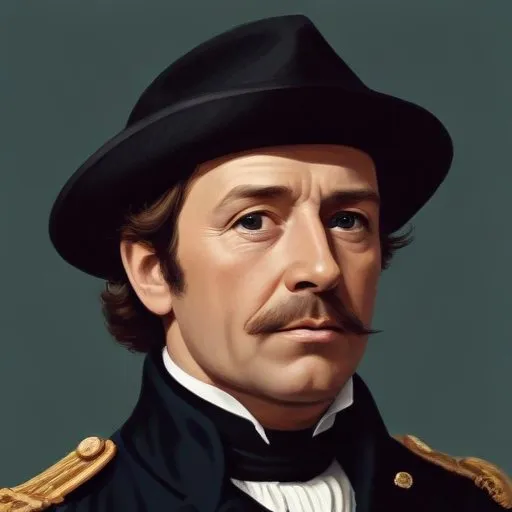
Sir James Clark Ross: The Fearless Polar Explorer
A Life Dedicated to Uncharted Territories
Sir
James Clark Ross is renowned for his groundbreaking expeditions to the Arctic and Antarctica, earning him a place among the most celebrated polar explorers in history. His unwavering commitment to charting the uncharted and expanding human knowledge of the world's most inhospitable regions has left an enduring legacy in the fields of navigation, magnetism, and natural history.
Early Life and Naval Career
Born on April 15, 1800, in London, Ross was the son of George Ross and nephew of
John Ross, a distinguished Royal Navy officer. He entered the Royal Navy on April 5, 1812, and soon found himself participating in the Napoleonic Wars. Ross served under his uncle on various ships, including HMS
Actaeon and HMS
Driver, where he demonstrated his naval prowess.
Arctic Exploration
Ross's true calling, however, lay in the Arctic. He participated in his uncle's unsuccessful first Arctic voyage in search of a Northwest Passage in 1818. Undeterred, Ross joined four Arctic expeditions led by William Edward Parry between 1819 and 1827. During this period, he developed a keen interest in magnetism and natural history. Ross's friendship with Francis Crozier, who would later become his close friend and second-in-command, also dates back to this period.
The Discovery of the North Magnetic Pole
Ross's most significant achievement came during his uncle's second Arctic voyage (1829-1833). On June 1, 1831, Ross led a small party, which included Thomas Abernethy, to locate the position of the north magnetic pole on the Boothia Peninsula in northern Canada. This milestone marked the first time the pole had been accurately charted. Ross personally planted the British flag at the pole, etching his name in the annals of exploration history.
Antarctic Expedition
Between 1839 and 1843, Ross embarked on his own Antarctic expedition, commanding HMS
Erebus and HMS
Terror. During this expedition, he charted the coastline of Antarctica, discovering the Ross Sea, Ross Island, and the Victoria Land region. Ross's meticulous observations and recordings of the Antarctic environment laid the foundation for future scientific research in the region.
Literary Contributions
Ross's expeditions yielded a treasure trove of scientific data and observations, which he meticulously documented in his writings. His book,
A Voyage of Discovery and Research in the Southern and Antarctic Regions, serves as a testament to his dedication to sharing his findings with the scientific community.
Awards and Honors
Ross's contributions to the fields of navigation, magnetism, and natural history earned him numerous accolades. He was knighted in 1843 for his services to British exploration and science. The Royal Geographical Society awarded him the Founder's Medal in 1842, recognizing his outstanding achievements in Antarctic exploration.
Legacy
Sir James Clark Ross's expeditions not only expanded our understanding of the world's most inhospitable regions but also paved the way for future explorers and scientists. His groundbreaking discoveries have inspired generations of scientists, and his legacy continues to captivate the imagination of people around the world.
FAQ
Who was James Clark Ross and what were his contributions to Arctic exploration?
James Clark Ross was an English captain and explorer who made significant contributions to the exploration of the Arctic region. He was the first European to reach the North Magnetic Pole and discovered the Ross Sea and the Victoria Land region of Antarctica.
What was James Clark Rosss role in the search for the Northwest Passage?
Ross participated in several expeditions to search for the Northwest Passage, a legendary route through the Arctic region. He led an expedition in 1848-1849 that discovered the Ross Sea and the Victoria Land region of Antarctica.
How did James Clark Rosss expeditions contribute to the development of Arctic science?
Rosss expeditions contributed significantly to the development of Arctic science, including the study of magnetism, geology, and biology. He collected many scientific specimens and made observations that helped to advance our understanding of the Arctic region.
What was James Clark Rosss role in the development of British Arctic policy?
Ross played a significant role in the development of British Arctic policy, advocating for further exploration and scientific research in the region. He was a strong supporter of the British Navys Arctic expeditions and helped to promote the importance of Arctic exploration.
How did James Clark Rosss legacy impact the development of modern Arctic exploration?
Rosss legacy as an Arctic explorer helped to establish the importance of scientific research in the region. His discoveries and contributions to the development of Arctic science paved the way for later explorers and researchers, including Robert Falcon Scott and Roald Amundsen.