


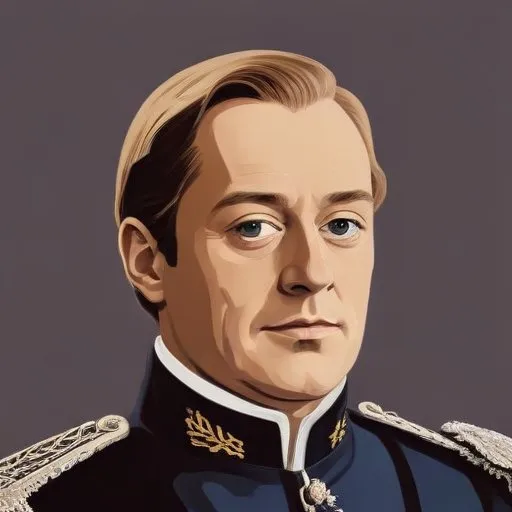
A German nobleman and last duke of Liegnitz, he's known for his attempts to maintain independence and power during the tumultuous 17th-century European wars. He's also remembered for his cultural achievements, including patronizing the arts and architecture.
George William, Duke of Liegnitz, is remembered as the last Silesian duke of Legnica, Liegnitz, and Brzeg, ruling from 1672 until his untimely death in 1675. He was the final male member of the Silesian Piast dynasty, descending from Władysław II the Exile, and the last legitimate male member of the entire House of Piast.
George William was born on September 29, 1660, to Duke Christian of Legnica-Brzeg and Princess Louise of Anhalt-Dessau. He was the eldest but only surviving son of the couple, and as such, became the sole heir to his father's possessions. George William had three siblings, Karolina, Louise, and Christian Louis, although he outlived them all.
Duke Christian of Legnica-Brzeg spent many years in exile in Poland and the Duchy of Prussia during the Thirty Years' War, after George William's grandfather, Duke John Christian of Brieg, fell out of favor with the Habsburg emperor Ferdinand II. Duke Christian became the sole ruler over the Silesian duchies of Legnica and Brzeg in 1664. After King John II Casimir Vasa of Poland abdicated in 1668, Duke Christian put forward his candidacy for the Polish throne, aiming to win the affection and support of the old nobility.
Although George William's reign was brief, he made significant attempts to strengthen the bonds between his duchy and Poland. He ensured that his son spoke Polish and wore Polish clothes, fostering a sense of unity between the two nations. Unfortunately, his early death prevented him from implementing any lasting reforms or policies.
George William's untimely death brought an end to the Silesian Piast dynasty, which had ruled over the region for centuries. His legacy is marked by his attempts to strengthen ties with Poland, and his status as the last male member of the House of Piast. Despite his brief reign, George William played a significant role in shaping the course of Silesian history.
George William, Duke of Liegnitz, may have had a short reign, but his impact on Silesian history is undeniable. As the last Silesian Piast, he represents the end of an era, and his attempts to strengthen ties with Poland foreshadowed the complex relationships that would shape the region in the centuries to come.
Born in 1591
Duke of Brzeg, a 15th-century Polish nobleman, ruled over the Duchy of Brzeg and was a skilled military leader and politician. He played a significant role in shaping the region's history.
