


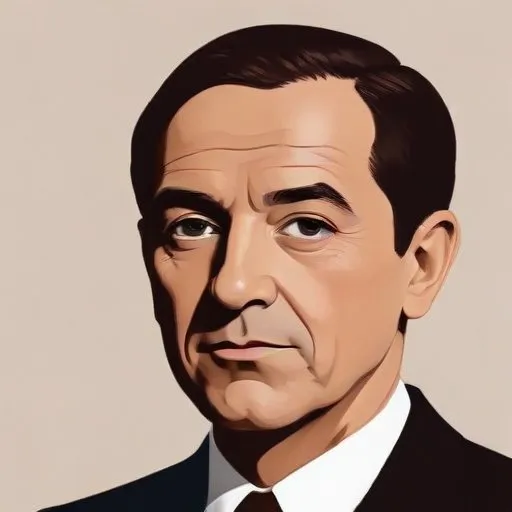
A French philologist and academic who pioneered the study of comparative mythology, uncovering parallels between ancient cultures and their mythological stories.
Georges Dumzil is renowned for his groundbreaking trifunctional hypothesis on Proto-Indo-European mythology and society, a concept that has revolutionized the fields of comparative mythology and Indo-European studies. His innovative research has shed new light on the shared mythological and cultural heritage of ancient civilizations, earning him a prominent place among the most influential scholars of the 20th century.
Born on March 4, 1898, in Paris, France, Georges Dumzil was the son of Jean Anatole Jean Dumzil, a highly educated general in the French Army, and Marguerite Dutier. His father's influence and the family's strong emphasis on education instilled in Dumzil a love for learning from an early age. He pursued his studies at the Collège de Neufchâteau, Lycée de Troyes, Lycée Louis-le-Grand, and Lycée de Tarbes, mastering Ancient Greek and Latin with ease.
It was during his time at the École normale supérieure (ENS) that Dumzil's fascination with Indo-European mythology and religion began to take shape. Under the guidance of Michel Bréal, a student of Franz Bopp, Dumzil learned Sanskrit and developed a deep interest in the mythological and cultural heritage of ancient civilizations.
Dumzil's magnum opus, the trifunctional hypothesis, posits that Proto-Indo-European societies were organized into three distinct social classes: priests, warriors, and producers. This hypothesis, which was first introduced in the 1920s, revolutionized the field of comparative mythology by providing a framework for understanding the shared mythological and cultural heritage of ancient civilizations.
The trifunctional hypothesis has far-reaching implications for our understanding of the social structures, mythological narratives, and cultural practices of ancient societies. Dumzil's work has inspired a new generation of scholars to explore the complexities of Proto-Indo-European mythology and society, leading to a deeper understanding of the shared cultural heritage of ancient civilizations.
Dumzil's academic career was marked by numerous honors and achievements. He taught at Istanbul University, École pratique des hautes études, and the Collège de France, and was elected a member of the Académie Française in 1954. His research has been recognized with the prestigious Prix Marcelin Guérin and the Prix Saintour, among other honors.
Dumzil's work has had a profound impact on modern scholarship, inspiring a wide range of academic disciplines, from comparative mythology and Indo-European studies to linguistics, anthropology, and cultural studies. His research has also influenced scholars outside of academia, inspiring new perspectives on mythology, culture, and society.
Today, Dumzil's legacy continues to inspire new generations of scholars, ensuring that his groundbreaking research remains a cornerstone of modern scholarship.
Dumzil's life was marked by significant personal milestones, including his service as an artillery officer in the French Army during World War I, for which he received the Croix de Guerre. His father, Jean Anatole Jean Dumzil, was inspectorgeneral of the French artillery corps during the war.
Through his groundbreaking research and influential teaching, Georges Dumzil has left an indelible mark on modern scholarship, ensuring that his legacy will continue to inspire and educate future generations of scholars.
99 Years Old
A French historian and philosopher who critiqued power structures and social norms, arguing that knowledge and truth are shaped by those in power. He's known for his concepts of power, discipline, and surveillance.
Born in 1915
A French philosopher, theorist, and critic who challenged traditional notions of culture, literature, and identity through his influential writings on semiotics, mythology, and structuralism. He's most known for his critical theories on modern society and culture.
Born in 1908
A founder of modern anthropology, known for structuralism and deciphering the underlying patterns of human culture and society. His work bridges the gap between sociology, psychology, and philosophy.
96 Years Old
A French sociologist, anthropologist, and philosopher who developed the concept of "cultural capital" and critiqued social inequality, highlighting how power and privilege are maintained through cultural and symbolic means.
Born in 1905
Existentialist philosopher and playwright who argued that humans have complete freedom to choose their actions and create their own meaning in life, influencing modern thought on morality and individual responsibility.
Born in 1908
A pioneering feminist philosopher who wrote extensively on ethics, politics, and gender, famously arguing that "one is not born, but rather becomes, a woman."
Born in 1913
A French novelist, philosopher, and journalist who wrote influential works like "The Stranger" and "The Plague", exploring absurdism and the human condition.
Born in 1924
A French philosopher, sociologist, and literary theorist who challenged traditional notions of knowledge, truth, and power, and is famous for his concept of "postmodernism".
