


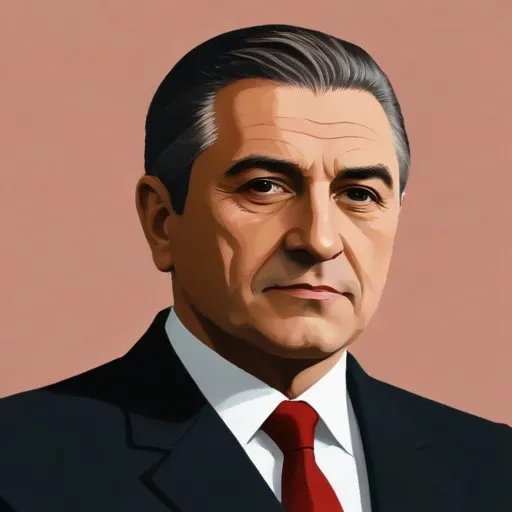
A Bulgarian historian and politician who served as the country's President from 2002 to 2012, known for his efforts to modernize and democratize Bulgaria. He played a key role in the country's accession to NATO and the EU.
Georgi Sedefchov Parvanov, born on June 28, 1957, in Sirishtnik, Pernik Province, Bulgaria, is a distinguished historian and politician who rose to prominence as the President of Bulgaria from 2002 to 2012. Throughout his career, Parvanov has been recognized for his contributions to Bulgarian history, politics, and social democracy.
Parvanov's educational pursuits began with his graduation from secondary school in Pernik in 1975. He then went on to earn his undergraduate degree in history from Sofia University in 1981, specializing in the history of the Bulgarian Communist Party. In 1988, he successfully defended his doctoral thesis, titled "Dimitar Blagoev and the Bulgarian national question (1879-1917)." His research interests have primarily revolved around the Bulgarian national issue and the early history of social democracy in Bulgaria.
In 2001, Parvanov's political career took a significant turn when he was elected as the President of Bulgaria, defeating incumbent Petar Stoyanov in the second round of the presidential election. He assumed office on January 22, 2002, and went on to serve two consecutive terms, becoming the first Bulgarian president to do so.
During his presidency, Parvanov actively supported Bulgaria's entry into NATO and the European Union. He also played a crucial role in shaping the country's social policy, earning him the reputation of a "social president." Parvanov's leadership saw significant economic growth, with Bulgaria experiencing a surge in foreign investment and a decline in unemployment rates.
As a self-identified socialist, Parvanov has been a strong advocate for social democracy and the principles of equality and justice. Throughout his political career, he has emphasized the importance of social cohesion and the need for Bulgaria to adopt a more inclusive and equitable economic model.
In 1981, Parvanov joined the Institute for History of the Bulgarian Communist Party as a researcher, marking the beginning of his academic and professional journey. He has since then been actively engaged in historical research and has published numerous works on Bulgarian history and politics.
Parvanov's presidency had a profound impact on Bulgarian society, as he worked to strengthen the country's international relationships and promote economic growth. His commitment to social democracy has inspired a generation of Bulgarian politicians and scholars, cementing his legacy as a pioneering figure in Bulgarian history.
Parvanov's political career has not been without controversy. Following his presidency, he faced opposition from within his own party, the Bulgarian Socialist Party (BSP), regarding his leadership and the direction of the party. This led to his departure from the BSP and the establishment of his own party, the Alternative for Bulgarian Revival (ABV), in 2014.
Georgi Parvanov's contributions to Bulgarian history, politics, and social democracy have left an indelible mark on the country's development. His presidency, marked by significant economic growth and international cooperation, has earned him recognition as one of Bulgaria's most important political leaders in modern times.
A comparative analysis of Parvanov's presidency with that of his contemporaries in Eastern Europe reveals a distinct focus on social democracy and economic growth. His commitment to European integration and his ability to navigate Bulgaria's complex political landscape have made him a standout figure in the region.
Georgi Parvanov's remarkable journey, marked by academic excellence, political acumen, and a commitment to social democracy, has left an enduring impact on Bulgarian history and politics.
91 Years Old
A Bulgarian philosopher and politician who served as the country's president from 1990 to 1997, known for his role in the country's transition from communism to democracy. He was a prominent figure in Bulgaria's post-communist era, advocating for human rights and democratic values.
89 Years Old
The 48th Prime Minister of Bulgaria, serving from 2001 to 2005, known for his efforts to reform the country's economy and integrate it into the European Union. He's a key figure in Bulgaria's transition to democracy.
