


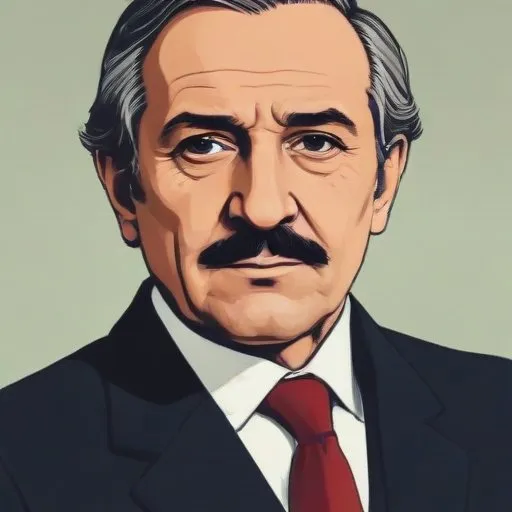
The 48th Prime Minister of Bulgaria, serving from 2001 to 2005, known for his efforts to reform the country's economy and integrate it into the European Union. He's a key figure in Bulgaria's transition to democracy.
Simeon SaxeCoburgGotha, also known as Simeon II, is best known for his brief yet tumultuous reign as the last tsar of the Kingdom of Bulgaria and his unexpected return to politics in the 1990s. Born on June 16, 1937, Simeon's life has been marked by dramatic twists and turns, from being thrust onto the throne at the age of six to becoming the Prime Minister of Bulgaria over five decades later.
Simeon was born to Boris III of Bulgaria and Giovanna of Italy, and his birth was marked by a unique baptism ritual, where an air force officer was sent to the Jordan River to obtain water for his Orthodox baptism. Tragedy struck when his father died in 1943, and Simeon succeeded to the throne at the tender age of six. Due to his youth, a regency council was established, comprising his uncle Prince Kiril, Prime Minister Bogdan Filov, and Lt. General Nikola Mihov of the Bulgarian Army.
As Bulgaria aligned itself with the Axis powers during World War II, Simeon's regents navigated the treacherous landscape of wartime politics. However, after the Soviet Union declared war on Bulgaria in 1944, the young tsar was forced into exile. This marked the beginning of a long period of self-imposed exile, during which Simeon would observe the dramatic changes sweeping across his homeland.
In 1996, after a 50-year absence, Simeon returned to Bulgaria and founded the National Movement for Stability and Progress (NMSP) party. His political gamble paid off when he was elected Prime Minister of the Republic of Bulgaria in 2001, a position he held until 2005. During his tenure, he formed a coalition government with the Bulgarian Socialist Party, further solidifying his reputation as a shrewd politician.
Simeon's life has been marked by a series of fascinating contradictions – from the tumultuous reign of a child tsar to the calculative politician who navigate the complexities of modern Bulgarian politics. Today, as one of the last living heads of state from World War II, Simeon SaxeCoburgGotha remains an enigmatic figure, whose legacy continues to fascinate and inspire generations.
Simeon SaxeCoburgGotha's life has been inextricably linked with the tumultuous history of Bulgaria, from the Axis powers to the post-communist era. As a symbol of the country's monarchical past and its modern-day democratic aspirations, Simeon's legacy serves as a testament to the power of perseverance and the human capacity to adapt to changing circumstances.
In contrast to other European monarchs of the 20th century, Simeon's experience is peculiar in its own right. While others were forced to confront the decline of their empires, Simeon's brief reign and subsequent exile set him apart. His later foray into politics, however, draws parallels with other heads of state who have successfully navigated the transition from monarch to democrat.
Born in 1895
The first and only king of Albania, ruling from 1928 to 1939, known for modernizing and secularizing the country, and his authoritarian regime.
Born in 1820
Unified Italy's first king, who played a key role in the country's unification and modernization. He's remembered for his strong leadership and diplomatic skills.
Born in 1892
The last emperor of Ethiopia, who led the country through a period of modernization and was a symbol of African independence, and is also revered as a deity by the Rastafari movement.
88 Years Old
The former King of Spain who reigned from 1975 to 2014, known for transitioning the country from dictatorship to democracy and playing a key role in preventing a military coup in 1981.
85 Years Old
The last king of Greece, reigning from 1964 to 1973, known for his tumultuous rule and eventual exile after a military coup. He's a symbol of Greece's transition from monarchy to democracy.
Born in 1921
The last king of Romania, ruling from 1927 to 1930 and again from 1940 to 1947, known for his efforts to resist Soviet influence and his role in the country's transition to communism.
Born in 1888
King of Yugoslavia from 1921 until his assassination in 1934, known for uniting the South Slavic nations into a single state. He played a key role in shaping the country's politics and economy.
