


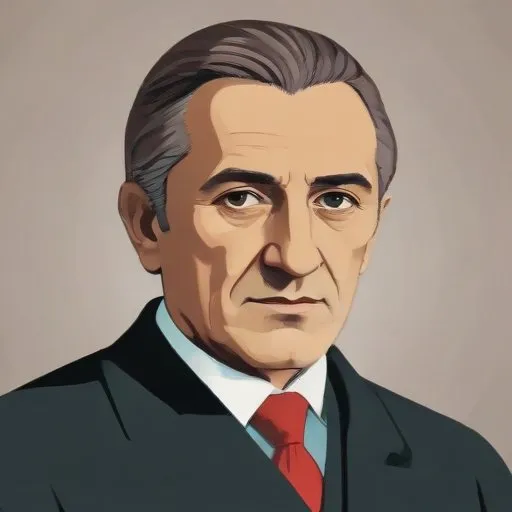
A Bulgarian philosopher and politician who served as the country's president from 1990 to 1997, known for his role in the country's transition from communism to democracy. He was a prominent figure in Bulgaria's post-communist era, advocating for human rights and democratic values.
Zhelyu Zhelev, a Bulgarian politician and former dissident, is renowned for being the first democratically elected and non-Communist President of Bulgaria, serving from 1990 to 1997. His presidency marked a significant turning point in Bulgaria's history, as it signaled the end of the 35-year rule of President Todor Zhivkov and the beginning of a new era of democracy.
Zhelev was born on March 3, 1935, in Veselinovo, a small village in northeastern Bulgaria. He came from a modest family and studied philosophy at Sofia University, graduating in 1958. Later, he earned a PhD in 1974, an impressive achievement considering he was expelled from the Communist Party in 1965.
Zhelev's early involvement with the Bulgarian Communist Party ended abruptly in 1965, when he was expelled for political reasons. This decision led to six years of unemployment, as all employment in Bulgaria was state-regulated. During this period, he was forced to live in virtual internal exile in his wife's village, where he took on odd jobs on farms to make ends meet.
In 1982, Zhelev published his controversial work, "Fascism," which drew parallels between fascist regimes and Communist states. The book was promptly removed from bookstores and libraries nationwide, but its impact was significant. The publication sparked a wave of dissent, and Zhelev became a prominent figure in the fight against communism.
In 1988, Zhelev founded the Ruse Committee, a pivotal organization that played a crucial role in the Fall of Communism. The committee's efforts paved the way for the formation of the Union of Democratic Forces, which would later propel Zhelev to the presidency.
Zhelev's presidency was marked by significant reforms and a commitment to democracy. He oversaw Bulgaria's transition from a communist to a democratic state, introducing market-oriented economic policies and promoting human rights. His legacy continues to inspire Bulgarians, and his unwavering dedication to democracy has earned him a place in history as a champion of freedom and human dignity.
Zhelev passed away on January 30, 2015, at the age of 79. Despite his passing, his legacy lives on, inspiring future generations to fight for freedom and democracy.
"Democracy is not just a form of government, but a way of life."
Zhelyu Zhelev's unwavering commitment to democracy and human rights has left an indelible mark on Bulgaria's history. His legacy serves as a testament to the power of courage and determination in the face of adversity.
68 Years Old
A Bulgarian historian and politician who served as the country's President from 2002 to 2012, known for his efforts to modernize and democratize Bulgaria. He played a key role in the country's accession to NATO and the EU.
60 Years Old
The 46th Prime Minister of Bulgaria, who served from 2005 to 2009 and is known for his efforts to reform the country's economy and bring it closer to the European Union. He is also the leader of the Bulgarian Socialist Party.
